
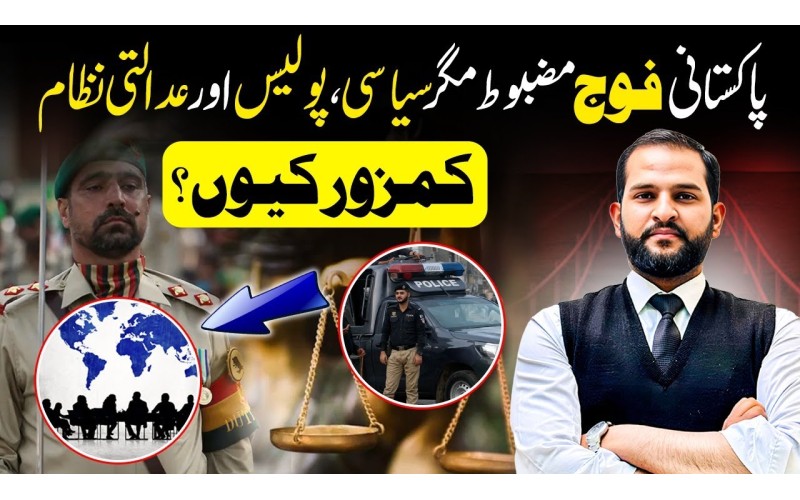
It is often said that the Pakistan Army is among the strongest militaries in the world. In global military rankings among approximately 145 countries, Pakistan consistently ranks near the top tier.
Yet, when we look at the rankings of political stability, judicial efficiency, and policing standards, Pakistan falls significantly behind.
This raises an important question:
Why did the military remain strong after independence, while political, judicial, and police institutions remained comparatively weak?
The Colonial Foundation: A Strong Army by Design
To understand this, we must revisit the British colonial period.
The British Empire ruled the subcontinent with one clear strategy: control through force. The army was their backbone. It was the primary instrument through which they maintained authority, suppressed rebellion, and protected imperial interests.
Because of this, the British heavily invested in:
-
A structured and disciplined military hierarchy
-
Organized infantry, artillery, and armored divisions
-
Signal corps and medical corps
-
Separate and properly designed naval and air forces
-
Professional command and training systems
By the time Pakistan (and India) gained independence in 1947, both inherited a well-organized, disciplined, and professionally structured military system.
That institutional strength continued after independence, which explains why both countries still rank high globally in military capability.
A Weak Political System by Design
Unlike the military, the political system was never designed to be powerful under British rule.
The British did not want a strong, independent democratic structure. They introduced limited representation primarily to release public pressure, not to transfer real power.
Real authority remained with:
-
The colonial administration
-
The Governor General
-
The British-controlled military
The political framework that was introduced favored:
-
Landlords
-
Feudal elites
-
Wealthy business families
-
Influential local power groups
After independence, these same elites continued dominating politics. The democratic structure was weak from the beginning, and it never fully evolved into a system based on strong institutions.
This was not accidental, it was structural.
The Judicial System: Slow, Complex, and Colonial
The judicial system inherited at independence was also colonial in character.
British laws in the subcontinent were designed to:
-
Protect colonial interests
-
Control dissent
-
Maintain order, not necessarily deliver speedy justice
The procedures were complex and slow. Legal technicalities benefited the elite who could afford prolonged litigation.
Judges were historically positioned to enforce imperial law rather than act as guardians of public interest. That colonial legacy persisted generation after generation.
At times, judicial activism emerged. At other times, judicial passivism dominated. But institutional reform remained limited.
As a result, public trust in the judicial system has struggled.
The Police System: Control Over Service
Perhaps the most deeply colonial institution is the police system.
The British did not design the police to serve the public.
They designed it to:
-
Maintain the writ of the state
-
Suppress rebellion
-
Enforce sedition laws
-
Control political dissent
-
Crush resistance
It was not a citizen-friendly institution. It was a control mechanism.
The police were given wide powers but limited accountability. Financial investment in policing remained weak. Salaries were low, but informal authority was high, creating space for corruption and abuse.
The culture that developed was one where:
-
Preventive detention was common
-
Political influence shaped arrests
-
Force was prioritized over service
That institutional culture has proven difficult to reform.
Why the Army Stayed Strong
The key difference is simple:
Investment and structure.
The military inherited:
-
Funding
-
Discipline
-
Organization
-
Strategic importance
The political, judicial, and police systems inherited:
-
Colonial control mechanisms
-
Weak democratic foundations
-
Elite dominance
-
Slow and complex procedures
Over time, the military continued receiving investment and structural support, while institutional reforms in civilian systems remained limited.
Conclusion
Pakistan’s institutional imbalance is not accidental, it is historical.
The army was designed to be strong.
The political system was designed to be limited.
The judiciary was designed to maintain colonial order.
The police were designed to enforce state control.
True institutional strength requires structural reform, accountability, public trust, and long-term investment.
Without reforming colonial legacies, civilian institutions cannot reach the level of institutional strength that the military inherited.