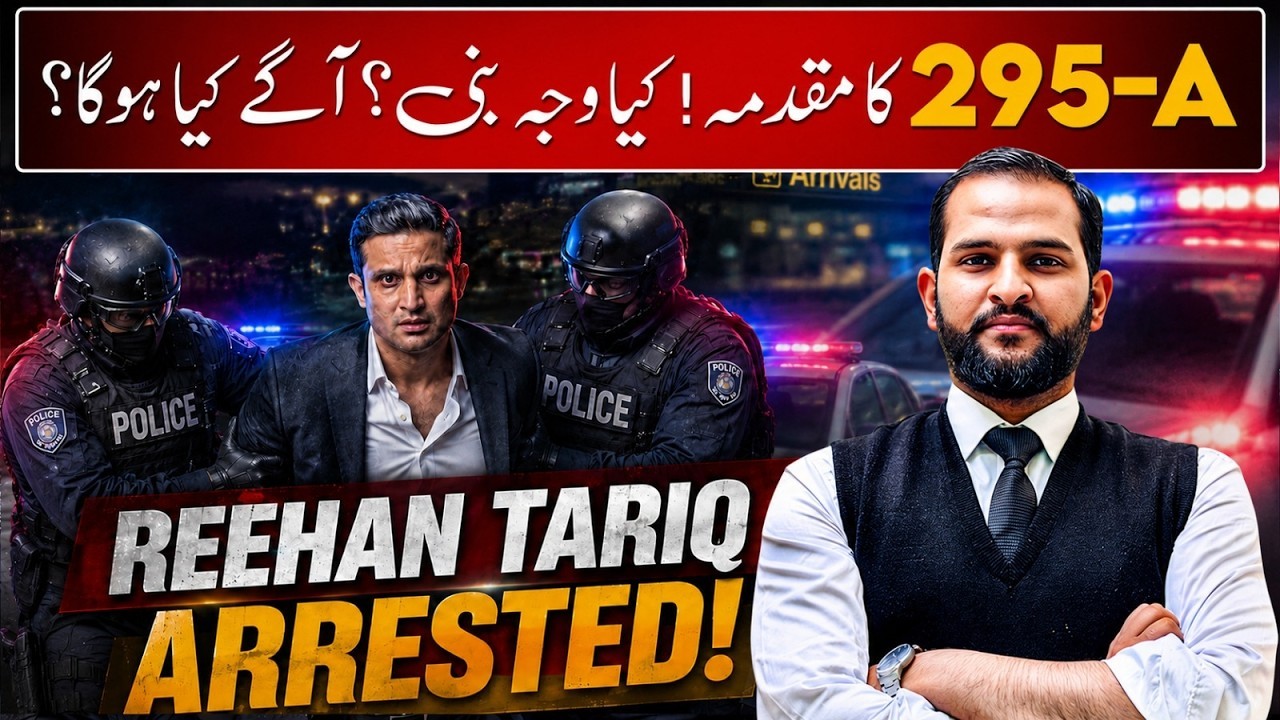
The recent arrest of television host Rehan Tariq has sparked widespread debate in Pakistan, raising important legal questions about freedom of expression, editorial responsibility, and the timing of law enforcement action.
The Controversial Podcast
On 24 June 2026 (8 Muharram), a podcast was uploaded on “RTS with Rehan”, hosted by Rehan Tariq. During the discussion, guest speaker Jawad Naqvi, a Shia religious scholar, made remarks concerning Hazrat Ameer Muawiya (RA) that many viewers considered controversial and offensive.
The podcast quickly attracted significant public criticism and backlash on social media.
Rehan Tariq Publicly Apologized
Following the controversy, Rehan Tariq issued a public apology, expressing regret to those whose religious sentiments had been hurt.
In his apology, he stated that if the podcast had caused pain to viewers, he sincerely apologized from the bottom of his heart. The apology was widely circulated across social media platforms.
Travel to the United Kingdom
After issuing the apology, Rehan Tariq travelled to the United Kingdom on 3 July 2026, where he continued uploading videos and remained publicly active.
According to available information, no travel restrictions, inquiries, or legal obstacles were reported before or during his departure from Pakistan.
Arrest Upon Return to Pakistan
On 8 July 2026, Rehan Tariq returned to Pakistan. Upon his arrival at the airport, he reportedly discovered that his name had been placed on the Passport National Identification List (PNIL), commonly referred to as the No-Fly List.
Authorities informed him that an inquiry had been initiated by the National Cyber Crime Investigation Agency (NCCIA). Following the inquiry, a criminal case was registered, and Rehan Tariq was taken into NCCIA custody.
He was subsequently produced before a competent court, which granted the investigating agency six days of physical remand for further investigation.
The outcome of the investigation, including whether he will receive further remand, be sent to judicial custody, or obtain release, remains subject to future court proceedings.
Questions Raised Over the Timing of the Arrest
The arrest has generated several legal and public policy questions.
One of the principal issues concerns timing. The controversial podcast had been uploaded on 24 June, and Rehan Tariq publicly apologized shortly afterwards. Despite this, he was allowed to travel abroad without any apparent restriction.
The question now being asked is why no immediate legal action was taken before his departure and why enforcement action occurred only after his return to Pakistan.
Editorial Responsibility
Another issue concerns editorial responsibility for content published on digital media platforms.
As the host of the program, Rehan Tariq undoubtedly played a central role in presenting the podcast. However, questions have also been raised regarding the responsibilities of producers, editors, and the guest speaker whose remarks triggered the controversy.
Legal experts note that determining individual criminal liability requires a careful examination of each person’s role in the creation, approval, and publication of the disputed content.
Freedom of Expression and Religious Sensitivities
The incident has once again highlighted the delicate balance between freedom of expression and respect for religious beliefs in Pakistan.
While individuals have the constitutional right to express their views within the limits of the law, content that is perceived to offend religious sentiments often attracts significant public reaction and may result in legal proceedings under applicable laws.
Media organizations and digital content creators are therefore expected to exercise greater editorial caution, particularly when discussing sensitive religious issues or inviting controversial guests.
Calls for Leniency
Some commentators argue that because Rehan Tariq publicly apologized soon after the podcast was released, his apology should be taken into consideration during the legal process.
Others maintain that any decision regarding criminal liability should ultimately be left to the investigating authorities and the courts after a full and impartial examination of the evidence.
Whatever the final outcome, the case is likely to become an important example in Pakistan’s evolving legal framework governing digital media, online publications, and accountability for controversial content.
Disclaimer: This article is based on publicly available information and reported developments. The allegations and legal proceedings mentioned remain subject to investigation and judicial determination. Every accused person is presumed innocent unless proven guilty by a competent court of law.