
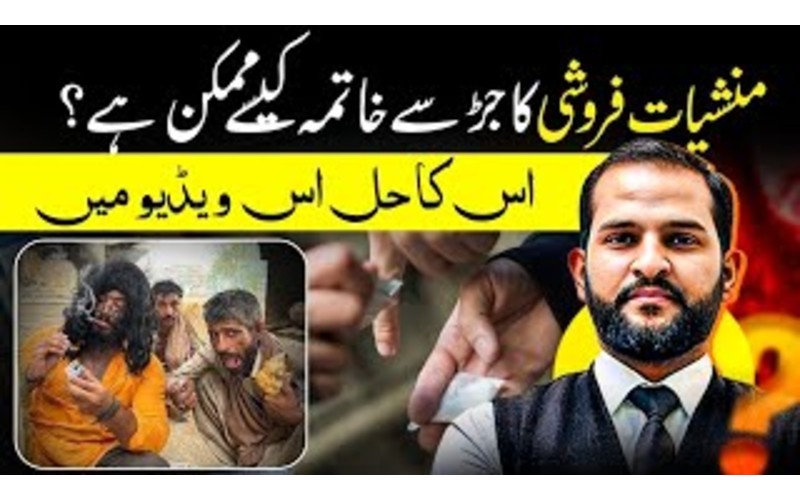
The responsibility to eliminate narcotics from Pakistan was primarily assigned to the Anti-Narcotics Force (ANF). Alongside ANF, the police were also tasked with taking action against drug dealers. In Punjab, an additional force, the Counter Narcotics Force (CNF), has also been established.
However, despite the presence of multiple law enforcement agencies, drug trafficking continues to thrive. This raises an important question: why has the system failed to control narcotics?
The Core Issue: Internal Complicity
One of the major reasons behind the failure is the alleged involvement of law enforcement officials themselves. It is widely believed that drug dealing cannot operate in any area without the backing or protection of certain police officials.
Where narcotics are openly sold, it is almost impossible that such activities are happening without someone influential “supporting” them behind the scenes.
Flawed Investigation Practices
When cases are registered, the standard narrative is often repeated:
- A “secret informer” provides information
- The police conduct a raid
- A suspect is arrested
- Narcotics are allegedly recovered from a bag
- A small portion (usually 5%) is separated for forensic analysis
After this, the investigation formally begins.
But a critical question arises:
Do investigators ever trace the source of the drugs?
- Who supplied the narcotics to the accused?
- Who is the dealer behind the chain?
- Who is the manufacturer?
- Who is the smuggler operating at a larger scale?
In most cases, these questions remain unanswered.
What the Law Actually Requires
Under narcotics laws, action should not be limited to the person caught with drugs. The law clearly requires authorities to proceed against:
- The supplier
- The dealer
- The facilitator
- The manufacturer
- The smuggler
In other words, the entire network should be dismantled , not just the lowest-level offender.
Targeting the Weak Instead of the Powerful
In practice, however, investigations focus only on the individual who is arrested, often a small-scale dealer. Instead of exposing the larger network, the system tends to make an example out of these individuals.
A disturbing trend has also been reported. Recently, a report presented before a High Court division bench revealed shocking allegations:
- Around 186 individuals accused of drug-related offenses had their legs broken
- The method allegedly involved sending them to jail, bringing them back on remand in minor cases, and then subjecting them to violence
- In some instances, injuries were justified by claiming the accused “fell” or were injured while trying to escape
Such practices raise serious concerns about abuse of power and human rights violations.
Lack of Strategy Against Drug Networks
The core issue is not just enforcement , it is the lack of a proper mechanism to target:
- Large-scale smugglers
- Organized networks
- Manufacturers and financiers
Instead, force is disproportionately used against small offenders, while larger players often remain untouched.
The Way Forward
There is no doubt that small-scale drug dealers should also be prosecuted and punished according to the law. However, real progress can only be achieved if:
- Investigations are conducted thoroughly
- Supply chains are traced
- Major networks are dismantled
- Law enforcement is held accountable
Without addressing these structural flaws, narcotics cannot be eliminated from society.
Conclusion
Drug control is not just about arrests, it is about effective investigation, accountability, and targeting the root cause. Until the system shifts its focus from minor offenders to the larger networks behind them, the problem of narcotics will continue to persist.