
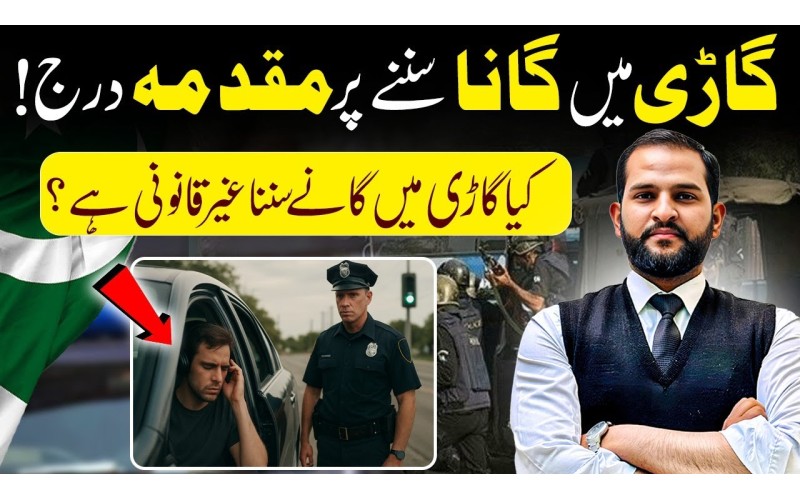
A Punjabi song, “Chanchardiyan Pawaan Chhankar,” recently became the basis of a criminal case registered against a citizen named Dani Shali. The incident allegedly occurred on the night of 10 September 2025, when Dani Shali was traveling on Dostri Eidi Road in his car.
According to the First Information Report (FIR), ASI Rehmat Ali stopped the vehicle at a police checkpoint and registered a case under Section 6 of the Sound System Regulation Act, 2015, claiming that loud music was being played. The FIR further records that when questioned, Dani Shali stated he was coming from Gulberg via Dost Market, and that he habitually listens to music at a high volume while traveling.
This entire conversation has been recorded verbatim in the FIR, which was registered at Nawab Town Police Station.
A Pattern of Misuse
This is not an isolated incident. Over time, several clients have approached me with similar complaints. In many cases, individuals were stopped by the police while traveling in their vehicles, listening to music inside their cars. The music was not audible outside the vehicle, yet cases were still registered against them under the Sound System Regulation Act.
In most of these situations, the real issue was not the sound itself—but a verbal altercation between the citizen and the police officer. When such disagreements occur, the police often use their authority to register an FIR under various pretexts, such as:
-
Sound system violations
-
Interference in government duties
-
Speeding
-
One-wheeling
-
Minor theft or public nuisance
Such practices are contrary to law and due process.
Purpose of the Sound System Regulation Act, 2015
To understand the misuse, it is important to understand why this law was enacted.
After the tragic APS Peshawar attack in 2014, Pakistan adopted the National Action Plan (NAP) to curb terrorism and sectarian violence. One key concern was the misuse of sound systems and amplifiers in:
-
Mosques
-
Imambargahs
-
Shrines
-
Other religious places
These sound systems were often used to spread hate speech, sectarian slogans, and incitement to violence. Additionally, the law aimed to control excessive noise during weddings and social events, where loud music would disturb neighborhoods late into the night.
Thus, the core objectives of the Sound System Regulation Act, 2015 are:
-
Prevention of terrorism and sectarian hatred
-
Protection of public peace and tranquility
-
Prevention of public nuisance
Personal Space vs Public Nuisance
Listening to music inside one’s private space, including a personal vehicle, is not a crime by itself. Even if the music is morally or culturally objectionable to some, it does not become a criminal offense unless it violates the law.
A violation occurs only when the sound affects others—for example:
-
Patients in a hospital
-
Elderly persons at home
-
Neighbors or passersby
-
The general public in surrounding areas
The Act clearly hinges on the concept of public disturbance.
Legal Flaws in Such FIRs
If ASI Rehmat Ali genuinely believed that the music constituted a legal violation, it was mandatory during investigation to:
-
Record statements of affected persons
-
Establish that the sound traveled beyond the vehicle
-
Prove that people were actually disturbed
Without such statements, the case suffers from serious legal doubt.
Furthermore, if the allegation involves the use of amplifiers, woofers, or large speakers, the police must:
-
Recover the equipment
-
Prepare a seizure memo (Fard-e-Makboozgi)
-
Attach the recovered items with the case file
Failure to do so raises a legitimate question about the genuineness of the FIR.
A Call for Accountability
I respectfully urge the Punjab Police, the CCPO Lahore, and all senior police officials to ensure that:
-
FIRs are registered strictly in accordance with law
-
Police powers are not misused for personal grudges
-
Citizens are not harassed under the pretext of minor laws
While genuine violations must be dealt with firmly, false and retaliatory cases erode public trust and undermine the rule of law.
Conclusion
If a song is played inside a car, and its sound does not travel outside, it does not constitute an offense under the Sound System Regulation Act, 2015. However, if powerful speakers or amplifiers are installed, and the sound disturbs the public, it may rightly attract legal consequences—provided the violation is properly investigated and documented.
Law is meant to protect public peace, not to become a tool of harassment.