
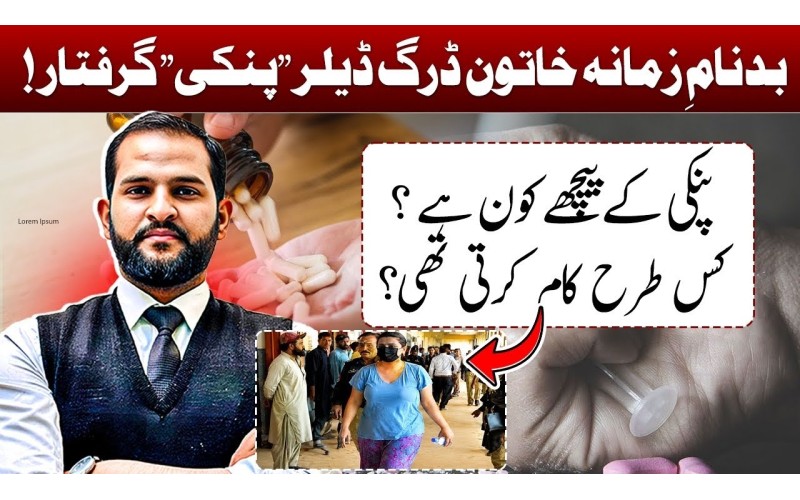
In May 2026, a case from Karachi captured widespread public attention across Pakistan. A woman commonly known as “Pinky” was arrested in connection with an alleged synthetic cocaine distribution network. When videos surfaced showing her being produced before a court without handcuffs, many people questioned whether she was receiving special treatment due to her alleged influence and connections.
This article examines the allegations against her and explains the legal position regarding the production of female accused persons before Pakistani courts.
Who Was “Pinky”?
According to media reports, Pinky was a Karachi-based woman accused of operating a sophisticated drug distribution network. Investigators alleged that she was involved in the manufacturing and sale of high-quality synthetic cocaine and had developed a large customer base that included influential individuals from major cities across Pakistan.
Authorities claimed that she marketed different categories of cocaine to her clients, including premium products allegedly sold at extremely high prices. Law enforcement agencies further alleged that the operation relied on female delivery riders, who were used to transport narcotics to customers across various locations.
Reports suggested that hundreds of clients were connected to the network and that the operation had been functioning for a significant period before her arrest.
Arrest and Recovery
On 12 May 2026, law enforcement authorities arrested Pinky from Karachi’s Garden area. During the operation, police reportedly recovered approximately one kilogram of processed synthetic cocaine along with several kilograms of chemicals allegedly used in the production process.
Investigators further claimed that substances such as ketamine and acetone were recovered, which are commonly associated with the manufacture and processing of synthetic narcotics.
Allegations of Biometric Evasion
One of the most discussed aspects of the case was the allegation that Pinky had intentionally damaged her thumbprints with acid. According to reports, this was allegedly done to prevent successful biometric verification and make identification more difficult for law enforcement agencies.
Authorities believe that the inability to verify fingerprints may have helped her avoid detection for a prolonged period.
The Public Reaction
Public debate intensified when videos emerged showing Pinky walking into court without handcuffs. Many social media users questioned why a person accused of running a large-scale narcotics operation was not restrained during court proceedings.
The criticism largely focused on whether influential accused persons receive preferential treatment within the criminal justice system.
However, the legal position regarding handcuffs is often misunderstood.
What Does Pakistani Law Say About Handcuffing Female Accused Persons?
Under Pakistani law and constitutional principles, the dignity of every individual must be respected, regardless of the allegations against them.
Article 14 of the Constitution
Article 14 of the Constitution of Pakistan, 1973 guarantees the dignity of man and the privacy of home. Courts have repeatedly emphasized that unnecessary humiliation of accused persons violates constitutional protections.
The use of handcuffs is generally viewed as a serious restriction on personal liberty and may amount to humiliation if used without lawful justification.
Supreme Court Guidelines
The Supreme Court of Pakistan has, in various judgments, held that handcuffs should not be used routinely. They may only be used in exceptional circumstances, such as:
- A significant risk of escape;
- A threat to public safety;
- Violent or dangerous conduct by the accused;
- Other extraordinary security concerns.
In ordinary circumstances, courts discourage the use of handcuffs merely because a person is facing criminal charges.
Special Considerations for Female Accused
Pakistani legal practice also recognizes additional safeguards for women in custody. Female accused persons are generally:
- Kept in facilities designated for women;
- Guarded by female police officials;
- Escorted by female constables during court appearances;
- Not routinely handcuffed unless exceptional circumstances exist.
For this reason, it is common to see female accused persons appearing before courts without handcuffs while accompanied by female police personnel.
Does the Absence of Handcuffs Mean Special Treatment?
Not necessarily.
The fact that an accused person appears in court without handcuffs does not automatically indicate preferential treatment. In many cases, it reflects compliance with constitutional protections and judicial guidelines regarding human dignity and personal liberty.
The key legal question is whether there were any exceptional circumstances requiring restraints. If no substantial risk of escape or violence existed, producing a female accused without handcuffs would generally be consistent with established legal principles.
Lessons from the Case
The Pinky case highlights several important issues:
- The growing challenge posed by organized narcotics networks.
- The need for effective law enforcement and accountability.
- The importance of respecting constitutional rights even when serious allegations are involved.
- The balance between public security and the dignity of accused persons.
While the criminal allegations against Pinky remain a matter for investigation and judicial determination, the controversy surrounding her court appearance provides an opportunity to better understand the legal protections available to all accused persons under Pakistani law.
Conclusion
The arrest of Pinky generated significant public interest due to the scale of the alleged drug operation and the circumstances surrounding her court appearance. Although many questioned why she was not handcuffed, Pakistani constitutional principles and judicial precedents generally discourage the routine use of restraints, particularly for female accused persons, unless exceptional security concerns exist.
The case serves as a reminder that the criminal justice system must pursue accountability while simultaneously upholding the rule of law, due process, and the dignity guaranteed by the Constitution of Pakistan.