

In narcotics cases, recovery alone is not enough to secure a conviction. The prosecution must strictly prove the safe custody of the recovered substance from the moment of seizure until forensic examination. Failure to establish this uninterrupted chain often results in acquittal, no matter how serious the allegation may be.
This principle was recently reaffirmed in the case of Naseem Shah alias Simi Shah, where a conviction of ten years’ imprisonment was set aside due to a break in safe custody.
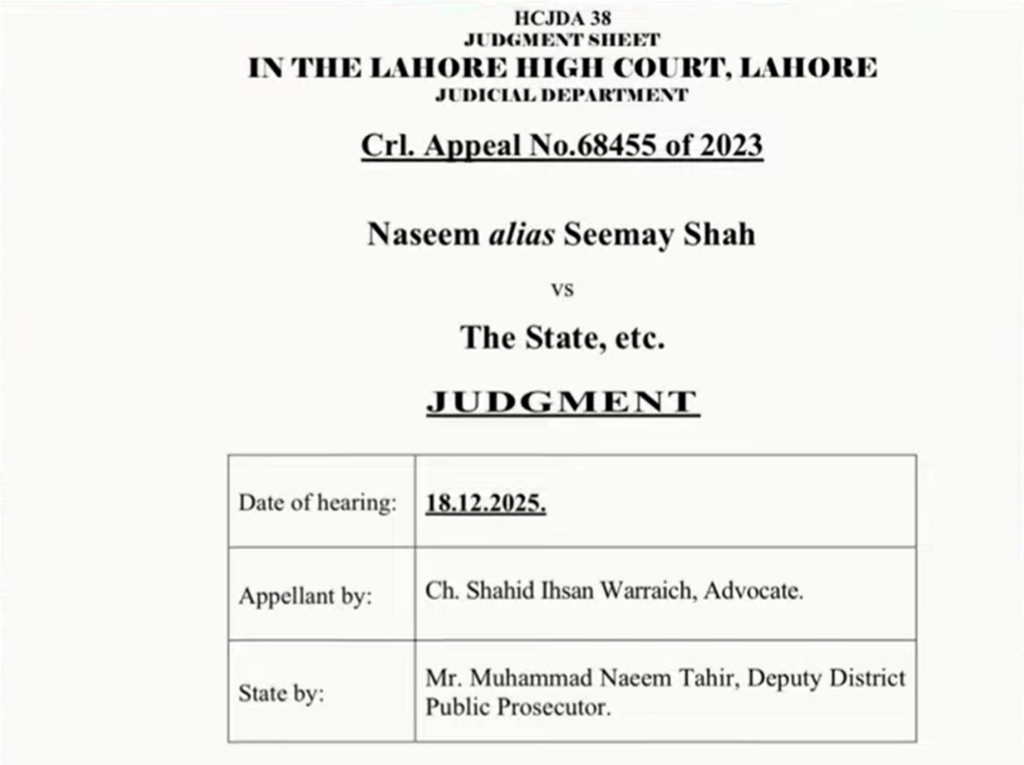
Judgment
What Is “Safe Custody” in Narcotics Law?
Safe custody refers to the unbroken, documented, and secure handling of recovered narcotics, ensuring that no tampering, substitution, or plantation is possible at any stage.
The law places this burden entirely on the prosecution, and even a minor inconsistency can prove fatal to the case.
Standard Legal Procedure After Recovery
When narcotics are recovered from an accused, the following procedure must be followed without deviation:
1. Preparation of Parcels
If 100 grams of narcotics are recovered:
- 95 grams are sealed for the malkhana (store)
- 5 grams are sealed as a sample for forensic analysis
2. Custody with the Moharrar
- The sealed parcels are handed over to the Moharrar
- Entries are made in Register No. 19
3. Handover to Investigating Officer
- Within 72 hours, the Investigating Officer (IO) must:
- Make an entry in Register No. 21
- Prepare a Road Certificate (RC)
- Make an entry in Register No. 21
4. Dispatch on the Same Day
- Sample parcel → Forensic Science Agency (PFSA)
- Bulk parcel → Malkhana
- Receipts are obtained and attached with the challan
- Challan is submitted in court within 14 days
This strict procedure exists to eliminate any possibility of planting or manipulation.
What Went Wrong in the Naseem Shah Case?
- FIR was registered on 13 October 2022
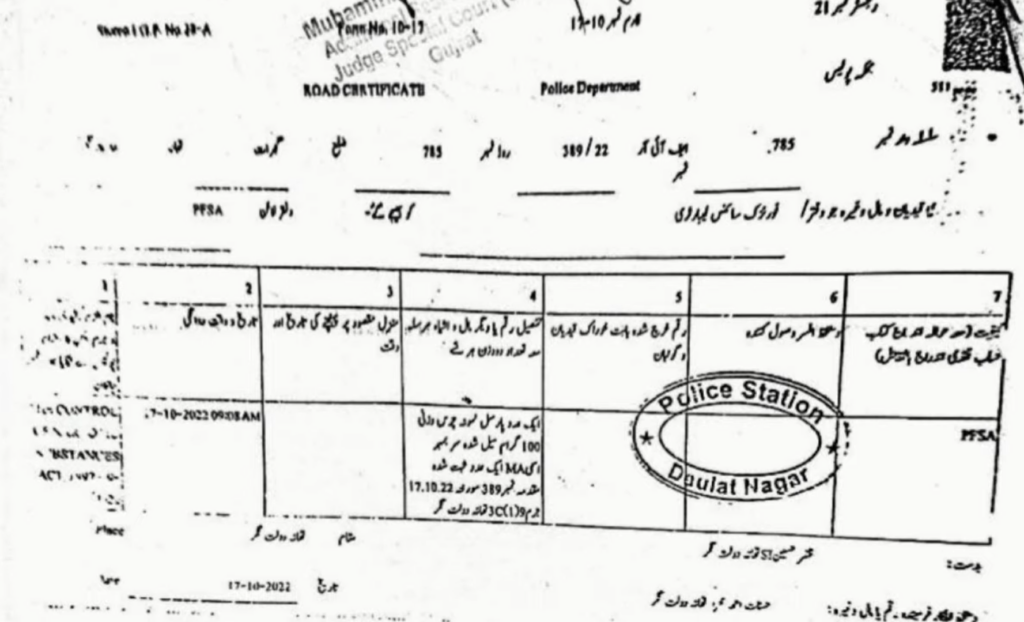
- Road Certificates were documented as prepared on 17 October 2022
- The Moharrar confirmed this date during cross-examination
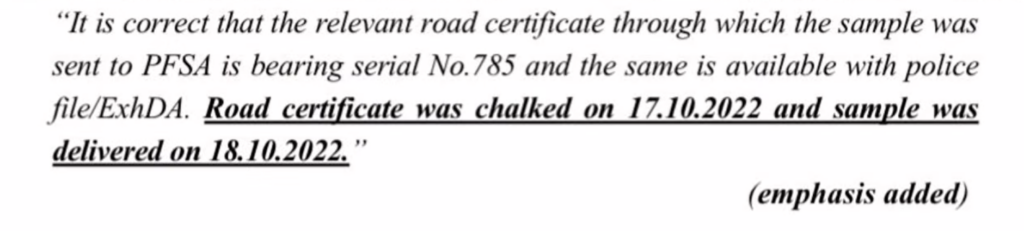
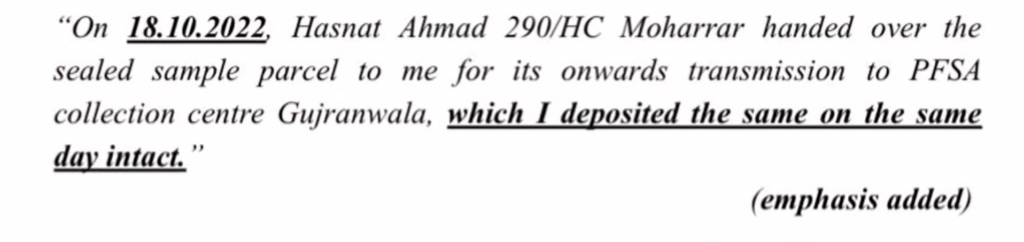
- However, the Investigating Officer claimed that:
- The RCs were prepared on 18 October 2022
- The parcels were deposited on the same day
- The RCs were prepared on 18 October 2022
This created a direct conflict between documentary and oral evidence.
Why the Court Granted Acquittal
The Division Bench, headed by Justice Farooq Haider and Justice Tariq Nadeem, observed that:
- The delay and contradictory evidence broke the chain of safe custody
- Parcels were retained without lawful explanation
- Possibility of tampering or plantation could not be ruled out
- Under settled law, benefit of doubt must go to the accused
As a result, the conviction and sentence were set aside.
Legal Principle Applied: Benefit of Doubt
Courts do not punish on suspicion. Even a single reasonable doubt regarding custody, handling, or timelines is sufficient for acquittal.
This reflects a core principle of criminal justice:
“It is better that ten guilty persons escape than one innocent suffer.”
A Larger Issue in Narcotics Prosecutions
In practice, many narcotics cases fail due to:
- Poor documentation
- Delayed dispatch to forensic labs
- Contradictory statements
- Non-compliance with mandatory registers
It is often observed that a vast majority of narcotics cases result in acquittal, not because the law is weak, but because investigations are careless or unlawful.
Conclusion
Narcotics laws are strict, but their enforcement must be stricter. Courts will not compromise on procedural safeguards, especially when liberty is at stake.
Unless law-enforcement agencies ensure:
- Transparent recoveries
- Immediate dispatch
- Proper documentation
- Consistent evidence
Acquittals will continue to occur.
Safe custody is not a formality it is the backbone of a narcotics prosecution.