
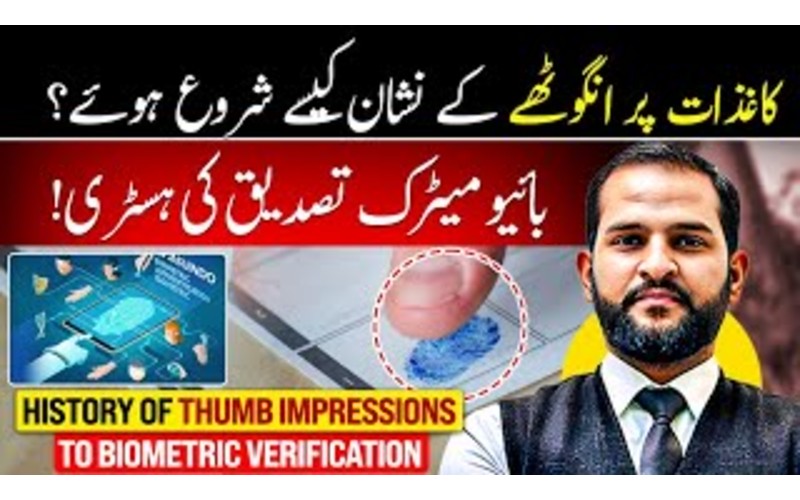
The practice of using thumb impressions, commonly known as “anghootha lagana”, has a long and fascinating history rooted in the need to prevent fraud and ensure authenticity in legal and contractual matters.
This system was first introduced in 1858 during the era of British rule in the Indian subcontinent, when present-day Pakistan, India, and Bangladesh were all part of British India. At that time, many individuals were unable to sign their names due to illiteracy. To protect such individuals from fraud in contractual agreements, Sir William Herschel pioneered the use of thumb impressions as a reliable method of identification.
Initially, a standard practice was followed: men would use the thumb impression of their right hand, while women would use that of their left hand. The ink used for thumb impressions was typically blue in color. The reason for using blue ink was quite practical, most official documents were written in black ink, so a contrasting color was necessary to clearly distinguish the thumb impression. Additionally, the paper used at the time often had a greenish or brownish tone, on which blue ink provided the clearest and most visible impression. Red ink was avoided because it did not reproduce well in photocopies (xerography), making it less reliable for documentation.
A major legal development occurred in 1872 with the introduction of the Indian Evidence Act, which established the framework for determining what constitutes admissible evidence in court. After the creation of Pakistan, this law was largely incorporated into the Qanun-e-Shahadat Order, 1984, which continues to govern evidentiary rules in Pakistan today.
Further advancements were made in 1897, when the world’s first Fingerprint Bureau was established in Calcutta. This marked a significant scientific breakthrough: it was officially recognized that every individual’s fingerprint is unique. The ridge patterns found in thumb impressions differ from person to person, making them a reliable form of identification.
By 1899, fingerprint evidence began to be formally accepted and used in legal proceedings. Over time, technological advancements expanded the use of fingerprints in criminal investigations. Law enforcement agencies started collecting fingerprints from crime scenes, such as glass surfaces, tables, and books, to identify suspects and solve cases.
In the modern era, this concept has evolved into biometric verification. The term “biometric” combines “bio” (life) and “metrics” (measurement), referring to the use of unique biological characteristics, such as fingerprints, for identification purposes. Advanced mathematical algorithms analyze these patterns to confirm an individual’s identity.
Today, biometric verification is widely used in multiple sectors. In Pakistan, it has become an essential part of the judicial system, where individuals are often required to verify their identity biometrically before filing a case. This helps prevent impersonation and fraudulent litigation. Similarly, modern banking systems rely heavily on biometric authentication to ensure secure transactions and customer verification.
Biometric technology continues to evolve rapidly, finding applications in areas ranging from law enforcement to digital security. What began as a simple method to protect illiterate individuals from fraud has now transformed into a sophisticated global system for identity verification and evidence collection.
Conclusion
In conclusion, the journey of thumb impressions from a basic identification method in the 19th century to today’s advanced biometric systems reflects the continuous evolution of law and technology. What started as a simple solution to protect vulnerable individuals from fraud has now become a critical tool in ensuring transparency, security, and authenticity across legal, financial, and administrative systems. As technology continues to advance, biometric verification will play an even more vital role in strengthening trust and preventing misuse in modern society.