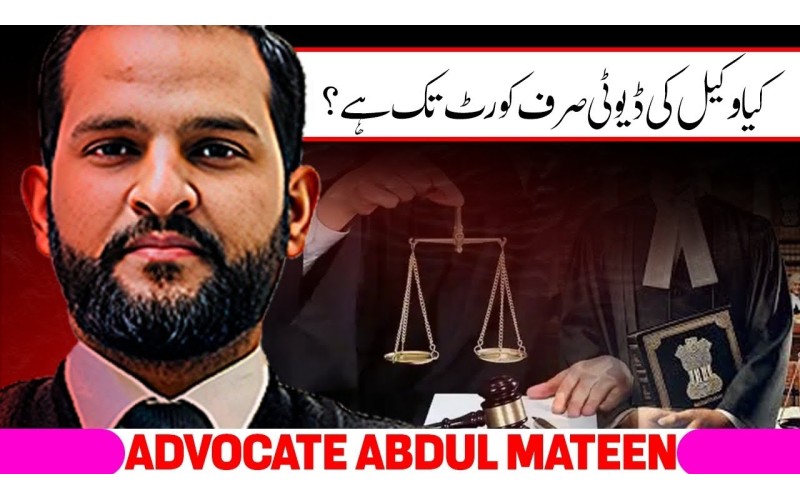
April 5, 2024, a date I will never forget.
It was the day I was arrested from my office.
Let me be clear: it was not my personal humiliation. I can endure that. What was humiliated that day was the sanctity of a lawyer’s office, the very space that represents the rule of law, constitutional protection, and professional independence.
There is a long-standing principle in legal practice: if a suspect is sitting in a lawyer’s chamber, you do not arrest the suspect in a manner that violates professional privilege and dignity. Yet instead of respecting that principle, the authorities chose to arrest the lawyer himself. The following day, they registered a terrorism case against me.
My alleged crime? I made a video.
The video was recorded inside a police station. It documented individuals who, according to my understanding and professional assessment, had been subjected to unlawful treatment. For that act, documenting what I believed to be injustice, a case was initiated against me.
Inside the same High Court where citizens seek justice, where fundamental rights are meant to be protected, the right to information, the right to life, the right to liberty, I was publicly labeled a “troublesome lawyer” who enters police stations and records videos. The remark was made in open court, reportedly at the direction of a sitting judge, whose name I choose not to mention out of respect for the institution.
But let us ask an important question:
If a lawyer enters a police station, is it a crime?
Or is it the exercise of a constitutional duty?
The Role of a Lawyer Beyond the Courtroom
We were often told by some seniors that a lawyer’s responsibility ends at the courtroom door. Wear your coat, argue your case, and leave.
But I respectfully disagree.
This entire country belongs to its citizens. Public offices belong to the public. Public officials are accountable to the public. A lawyer is not merely an advocate inside four walls, a lawyer is a guardian of constitutional rights.
Wherever there is injustice, a lawyer must be present.
If illegal detentions occur inside police stations, if arrests are made outside jails without due process, if fundamental rights are violated, it is not only our right but our duty to intervene.
Article 10A of the Constitution, introduced in 2010, guarantees the right to a fair trial and due process. But a fair trial begins with a fair investigation. And a fair investigation demands transparency and legal representation at every critical stage, including at the police station.
How can fairness exist if a citizen is isolated from legal counsel?
The Case of Mahnoor Bajwa
Let me refer to a recent example.
Public statements were made labeling an individual as a “dangerous criminal.” An IT team was formed. Past cases were scrutinized. A narrative was built. The familiar story was presented, surveillance, pursuit, confrontation.
We have all seen these templates before. They appear in FIRs every day. We hear them in courtrooms every week.
But even if, for the sake of argument, someone is accused of serious crimes, does that eliminate their constitutional rights?
If a person is arrested, why is their lawyer, even if that lawyer is their sister, not allowed to accompany them? What principle of fair investigation justifies isolation?
The Constitution does not differentiate between popular and unpopular defendants. Rights are not selective. Due process is not optional.
Changing the Legacy
There is a legacy within the legal profession that needs reform, the idea that a lawyer’s responsibility is confined to the courtroom.
I reject that limitation.
A lawyer’s duty exists wherever injustice exists.
If oppression happens in a police station, the lawyer must be there.
If illegal detention occurs, the lawyer must be there.
If state power overreaches, the lawyer must stand between authority and the citizen.
That is not activism.
That is constitutionalism.
My arrest on April 5, 2024, was not just about me. It was about defining the boundaries of a lawyer’s role in society.
If entering a police station to document potential abuse is treated as terrorism, then we must seriously ask: who is defending the Constitution?
I remain firm in my belief that the legal profession is not a passive occupation. It is a public trust.
And I will continue to honor that trust, inside the courtroom and beyond it.