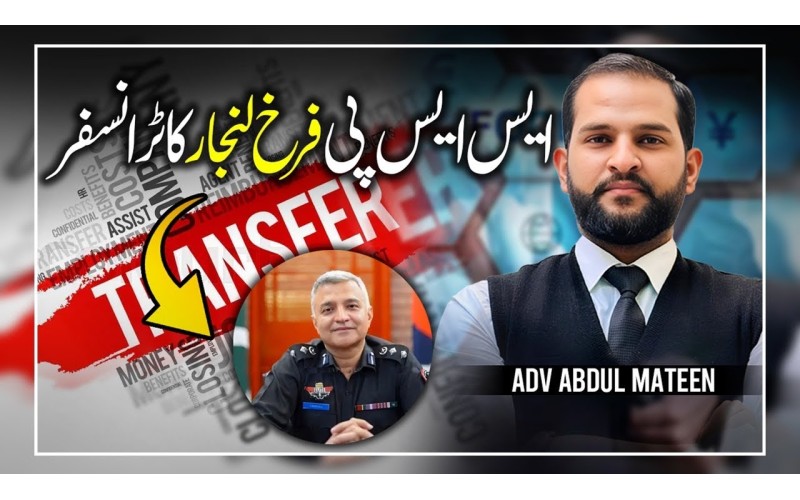
After three days of tense developments, SSP Dr. Farukh Lanjhar was transferred from his position. The SSP of Tando Muhammad Khan was posted as SSP Hyderabad, while Dr. Farukh Lanjhar was sent on leave.
The incident sparked strong reactions across Pakistan. Law students and members of the legal fraternity claimed that the “black coat” had prevailed. Meanwhile, some police constables expressed support for SSP Lanjhar’s actions.
However, the real question is not about individuals, it is about the rule of law.
The Legal Context
Under traffic regulations, the following are prohibited:
- Use of printed or tinted vehicle glass
- Use of unauthorized green number plates
These are unlawful acts. However, the law also clearly provides the prescribed penalties:
- Vehicle confiscation
- Fine ranging between Rs. 2,500 to Rs. 10,000
- Removal of illegal coverings
These are administrative or traffic violations, not serious criminal offences.
The Controversy
Instead of applying traffic penalties, the matter escalated.
A lawyer was reportedly arrested, forcibly taken to the police station by constables and security personnel, detained for hours, and then charged under multiple sections of the Pakistan Penal Code, including sections such as 147, 149, 186, 353, 504, and 506, despite the absence of substantial criminal material.
Critics argue that this was an act driven by ego and misuse of authority rather than lawful enforcement.
Supporters argue that no one, including lawyers, is above the law.
But the central issue remains: Was the law followed correctly?
A Victory of Law, Not of a Profession
This situation is not a victory of lawyers over police.
It is a victory of lawful procedure over misuse of power.
When a member of the legal fraternity faces perceived injustice, bar associations across Pakistan, including Hyderabad, Karachi, Lahore, Peshawar, and Quetta,often unite in protest.
This incident demonstrated one important principle:
When professionals stand united against unlawful actions, institutional accountability becomes possible.
Lawyers and Accountability
Let it be clear:
Lawyers are not above the law.
If a lawyer commits an offence, they must face legal consequences.
However, punishment must be:
- According to law
- Proportionate
- Based on evidence
- Free from personal ego
When authority exceeds legal boundaries, corrective action, such as transfer, suspension, or dismissal, becomes necessary to maintain institutional balance.
Bureaucratic Mindset and Reform
One recurring criticism in Pakistan’s governance system is the lingering bureaucratic mindset inherited from colonial administration, a culture of authority over accountability.
Incidents like this highlight the need for:
- Clear procedural adherence
- Proper jurisdictional enforcement
- Respect between institutions
- Defined limits of police powers
Traffic matters, for example, generally fall under the domain of traffic police. Criminal prosecution requires lawful grounds and proper evidentiary basis.
A Broader Message
This episode sends a wider message:
- Lawyers cannot be unlawfully suppressed.
- Police officers must act within legal limits.
- Citizens must also respect the law.
When any segment of society faces injustice, collective and lawful resistance becomes a constitutional right.
Final Thoughts
In the end, personalities fade, but principles remain.
This incident reinforces a fundamental truth:
Power is temporary. The rule of law must be permanent.
For Pakistan to move forward, institutions must respect boundaries, enforce laws fairly, and act without arrogance or prejudice.
Because justice is not about authority,it is about legality.