
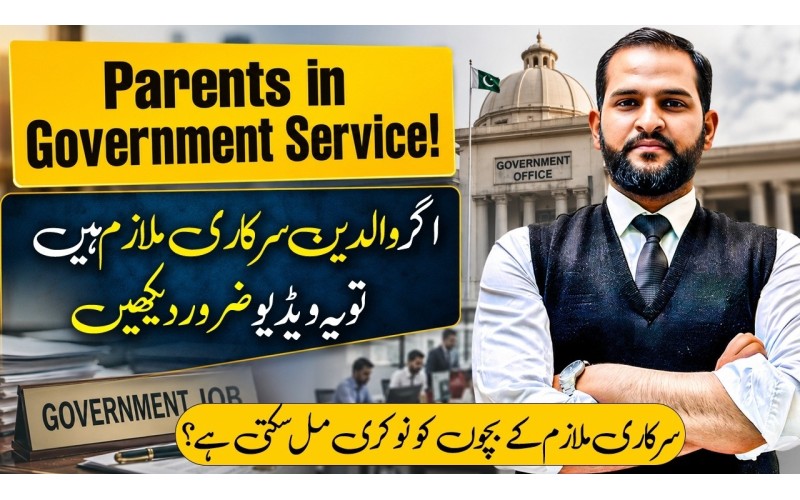
The question of whether the children of government employees are still entitled to government employment under Rule 17 has remained one of the most debated legal issues in recent years. A recent judgment authored by Justice Faisal Zaman Khan of the Lahore High Court has comprehensively clarified the legal position by analyzing decisions of the Supreme Court, the Federal Constitutional Court, the Lahore High Court, and the Sindh High Court.
This judgment brings much, needed certainty to the law governing compassionate appointments after the retirement or death of a government employee.
What Was Rule 17?
Rule 17 was part of the Punjab Civil Servants Rules and provided a compassionate appointment scheme. Under this provision, if a government employee died during service or retired under circumstances covered by the rule, one eligible son or daughter could be appointed to a government post without undergoing the normal competitive recruitment process.
Similar provisions also existed in other jurisdictions:
- The Federal Government had its own corresponding rule.
- Khyber Pakhtunkhwa operated under Rule 11-A.
- Balochistan had Rule 12.
- Sindh also maintained similar compassionate appointment provisions.
Although the rule numbers differed, the objective remained the same: to provide financial support to the family of a government employee by offering employment to an eligible child.
Supreme Court Declares the Rule Unconstitutional
The issue reached the Supreme Court in the landmark Jalal Case, reported as PLD 2024 Supreme Court 76.
After hearing all stakeholders, including the Provincial Government, the Supreme Court held that appointments made without advertisement, open competition, or merit-based recruitment violate the constitutional guarantees of equality and equal opportunity in public employment.
The Punjab Government informed the Court that it had already abolished Rule 17 through a notification dated 26 July 2024.
The Supreme Court consequently declared such compassionate appointment provisions unconstitutional and held that government jobs could no longer be granted solely because an applicant’s parent had served as a government employee.
An Important Question Remained
While the Supreme Court declared the rule unconstitutional, one important issue remained unresolved:
What would happen to appointments already made before Rule 17 was abolished?
Would those employees lose their jobs?
Lahore High Court Protects Existing Appointments
Following the Supreme Court judgment, numerous petitions were filed before the Lahore High Court.
A consolidated judgment held that the abolition of Rule 17 could not operate retrospectively. Therefore:
- Individuals who had already been appointed under Rule 17 before its abolition would continue in service.
- Their appointments could not be cancelled merely because the rule had subsequently been declared unconstitutional.
Although this judgment was challenged before a Division Bench, the appellate court ultimately upheld the principle that existing appointments remained protected.
Another Legal Issue Emerged
A separate question then arose:
What about those applicants whose parents had died or retired before 26 July 2024 but who had not yet received appointments?
Would they still be entitled to claim employment under Rule 17?
Supreme Court Clarifies the Position in 2026
The Supreme Court revisited the issue in 2026 and clarified that the Jalal judgment would not have retrospective effect.
The Court held that if the death or retirement of a government employee occurred before 26 July 2024, the legal right under Rule 17 had already accrued on that date.
Accordingly:
- The subsequent abolition of Rule 17 could not extinguish that vested right.
- Eligible applicants could still seek appointment, provided they fulfilled the prescribed eligibility criteria and suitable vacancies were available.
Federal Constitutional Court Agrees
The Federal Constitutional Court also endorsed the same legal principle.
It reaffirmed that, unless expressly provided otherwise, the repeal or abolition of a law does not operate retrospectively. Rights that have already accrued under an existing law remain protected.
Therefore, where a government employee had died or retired before Rule 17 was abolished, the eligible child retained the legal right to seek appointment, subject to eligibility requirements and the availability of vacancies.
Justice Faisal Zaman Khan’s Latest Judgment
Justice Faisal Zaman Khan consolidated all previous judicial precedents into a detailed and well-reasoned judgment.
The case involved a petitioner whose father had served as a Patwari (BS-9) and retired on 23 December 2023, well before Rule 17 was abolished.
The petitioner was appointed in 2025, but the appointment notification was subsequently withdrawn by the authorities.
The Lahore High Court set aside the withdrawal notification for two principal reasons:
- Violation of the Right to Fair Trial: The petitioner was not provided an opportunity to be heard before cancellation of the appointment, violating constitutional guarantees of due process.
- Protection of Accrued Rights: Since the petitioner’s father had retired before 26 July 2024, the petitioner’s right under Rule 17 had already vested. The subsequent abolition of the rule could not retrospectively deprive him of that right.
The Court therefore directed that the petitioner’s appointment be restored.
Key Legal Principle
The latest judicial position may be summarized as follows:
- Rule 17 was abolished in Punjab on 26 July 2024.
- No fresh rights arise after that date merely because a parent is a government employee.
- However, where a government employee died or retired before 26 July 2024, the eligible child’s legal right under Rule 17 had already accrued.
- Such vested rights cannot be taken away retrospectively unless the law expressly provides otherwise.
- Applicants must still satisfy all eligibility requirements, and appointments remain subject to the availability of sanctioned vacancies.
Conclusion
The latest judgment of the Lahore High Court, read alongside the decisions of the Supreme Court and the Federal Constitutional Court, establishes a clear legal position: although Rule 17 has been abolished, its repeal does not retrospectively extinguish rights that had already accrued before 26 July 2024.
Accordingly, if a government employee retired or died before the abolition of Rule 17, an eligible child may still claim compassionate appointment, provided the statutory conditions are fulfilled and a suitable vacancy exists. Existing appointments made under Rule 17 before its abolition also remain legally protected and cannot be cancelled solely because the rule was later declared unconstitutional.