
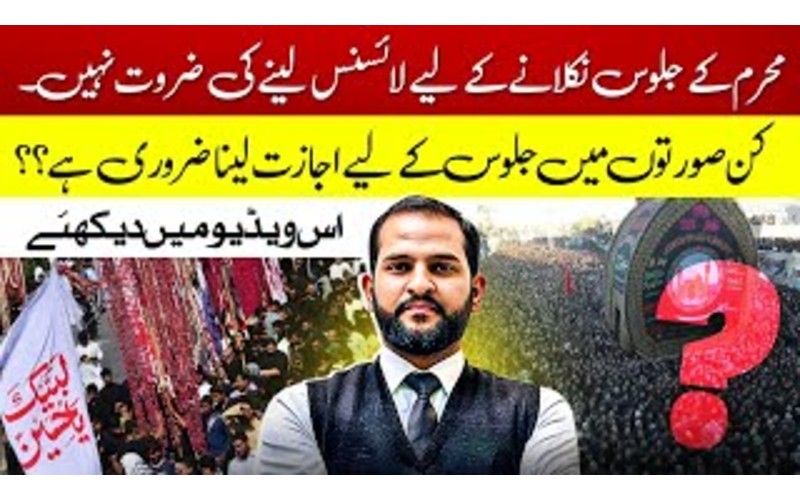
A significant constitutional matter came before the Multan Bench of the Lahore High Court concerning the right to organize a religious procession during the month of Muharram. The petitioner, Syed Wasi Haider, sought permission to organize an 8th Muharram procession in commemoration of the martyrdom of Hazrat Abbas (RA). However, both the civil administration and police authorities had declined to grant permission, despite similar processions having been allowed in previous years.
The matter was heard by Justice Amjad Rafiq, who delivered an important judgment balancing religious freedom with public order considerations.
Distinction Between Private and Public Religious Gatherings
The Court clarified that religious gatherings generally fall into two categories:
- Private Gatherings Events held within a private residence or private premises.
- Public Gatherings or Processions Events conducted on public roads, streets, or other public places.
According to the judgment, if a person wishes to hold a religious gathering (Majlis) within a private house or private premises, no formal license is required. The organizers are only expected to inform the local Station House Officer (SHO) so that appropriate security arrangements can be made and any potential threats can be addressed in advance.
When Is a License Required?
The Court further explained that a license is generally required only when a procession or gathering is intended to take place on public roads, streets, or other public spaces.
For obtaining permission, an applicant may submit a simple application to:
- The District Police Officer (DPO); and/or
- The Deputy Commissioner (DC).
The judgment emphasized that authorities should not unnecessarily restrict religious activities unless there is a genuine concern regarding public peace and security.
Constitutional Protection of Religious Freedom
The Court relied upon fundamental rights guaranteed under the Constitution of Pakistan, 1973.
Article 20 Freedom to Profess Religion
Article 20 guarantees every citizen the right to profess, practice, and propagate his or her religion, subject to law, public order, and morality.
Article 16 Freedom of Assembly
Article 16 recognizes the right of citizens to assemble peacefully and without arms, subject to reasonable restrictions imposed in the interest of public order.
The Court observed that religious gatherings and processions are protected constitutional activities, provided they do not threaten public peace or law and order.
Duties of the Administration
The judgment also placed important responsibilities upon district administrations and police authorities.
Where concerns regarding public order exist, the Deputy Commissioner and District Police Officer must work together to find practical solutions rather than simply rejecting applications.
Instead of issuing blanket refusals, authorities should:
- Engage with organizers;
- Assess security concerns objectively;
- Suggest alternative routes where necessary;
- Facilitate the exercise of constitutional rights while maintaining public order.
Timely Processing of Applications
An important direction issued by the Court was that applications for Muharram processions should be received and processed well in advance.
The administration was directed to:
- Receive applications approximately one month before Muharram;
- Decide such applications promptly;
- Communicate decisions without unnecessary delay; and
- Provide suitable routes or arrangements where security concerns exist.
Significance of the Judgment
This judgment serves as an important judicial precedent on the relationship between religious freedom and public administration in Pakistan. It reaffirms that citizens have constitutional rights to practice their religion and hold peaceful assemblies, while also recognizing the state’s responsibility to maintain law and order.
Particularly during Muharram, when many Muslims organize Majalis and processions to commemorate the sacrifice of Imam Hussain (RA) and other revered figures of Islamic history, the decision provides valuable guidance to both citizens and public authorities on how constitutional rights should be respected and facilitated.