
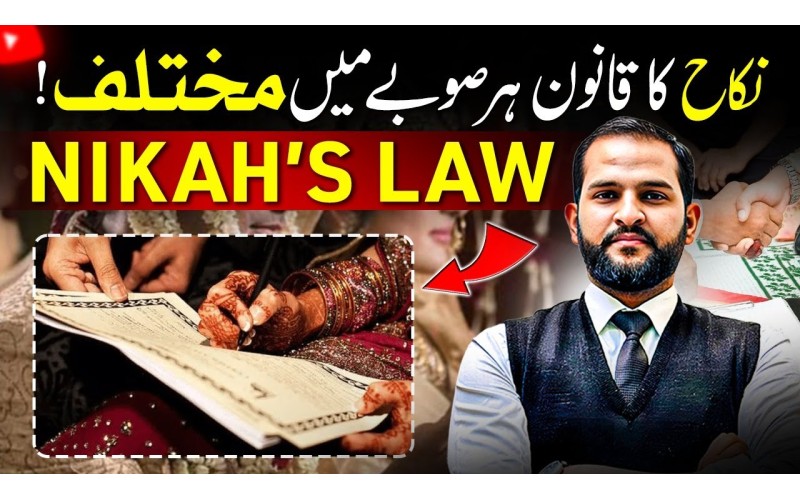
The question of the legal age for Nikah (marriage) in Pakistan often creates confusion, especially because marriage laws differ across provinces. This blog aims to clearly explain what the law says, where it applies, and how provincial differences affect legality.
1. Background: The Child Marriage Restraint Act, 1929
Initially, the Child Marriage Restraint Act, 1929 was a federal law applicable throughout Pakistan. Under this Act:
- Minimum age for boys: 18 years
- Minimum age for girls: 16 years
Any marriage conducted below these ages was considered an offence, and penalties could be imposed on those facilitating or solemnizing such marriages.
2. Impact of the 18th Constitutional Amendment
After the 18th Constitutional Amendment, the subject of marriage became a provincial matter. This means each province now has the authority to legislate its own laws regarding the age of marriage.
3. Province-Wise Legal Position
Sindh
In 2013, Sindh enacted its own law:
- Minimum age for both boys and girls: 18 years
Any marriage below this age is a criminal offence in Sindh.
Punjab
Punjab continues to follow the Child Marriage Restraint Act, 1929, with amendments made in 2015:
- Minimum age for boys: 18 years
- Minimum age for girls: 16 years
Penalties have been enhanced, but the age limits remain unchanged.
Khyber Pakhtunkhwa (KP) and Balochistan
Both provinces still apply the 1929 Act:
- Boys: 18 years
- Girls: 16 years
No significant amendments have been introduced so far.
Islamabad Capital Territory (ICT)
In 2025, a new law was passed specifically for Islamabad:
- Minimum age for both boys and girls: 18 years
This law applies only within the territorial limits of ICT.
Gilgit-Baltistan and Azad Jammu & Kashmir (AJK)
These regions are separate administrative units, not provinces or federal territories. They have:
- No specific legislation defining a minimum marriage age
- The 1929 Act is applied in practice
- Marriage is often assessed based on puberty (bulugh)
While child protection laws exist, there is no specific marriage-age legislation in these regions.
4. Inter-Provincial Marriages: Which Law Applies?
A common question is whether a marriage becomes illegal if parties move between provinces.
The key legal principle is:
The law of the province where the Nikah is solemnized and registered applies.
Examples:
- A girl aged 16–17 from Sindh marrying in Punjab:
✔ Legal in Punjab, because Punjab allows marriage at 16 for girls. - A girl aged 16–17 from Punjab marrying in Sindh:
❌ Illegal, because Sindh requires the girl to be at least 18.
5. Summary Table (Quick View)
| Region | Boy | Girl |
| Sindh | 18 | 18 |
| Islamabad (ICT) | 18 | 18 |
| Punjab | 18 | 16 |
| KP | 18 | 16 |
| Balochistan | 18 | 16 |
| Gilgit-Baltistan | Not fixed (1929 Act applied) | |
| AJK | Not fixed (1929 Act applied) |
Conclusion
There is no single uniform marriage age law across Pakistan. The legality of Nikah depends entirely on where it is performed, not where the individuals belong to. Anyone dealing with marriage registration, legal advice, or Nikah solemnization must carefully consider provincial laws to avoid criminal liability.
Understanding these distinctions is essential for lawyers, Nikah registrars, families, and individuals alike.