
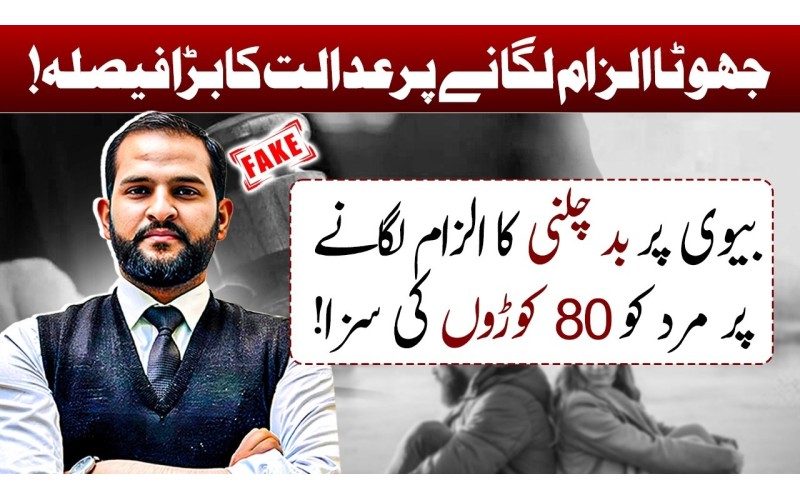
In many family disputes, serious allegations are exchanged between husbands and wifes. During divorce, khula, maintenance, or child custody cases, it is common to see one spouse accusing the other of having illicit relations with another person.
Sometimes, a wife files a khula suit and alleges that her husband was involved with other women. On the other hand, many husbands, while sending divorce notices or contesting maintenance claims, accuse their wifes of having relationships with other men. In certain cases, husbands even deny the paternity of children born during marriage.
But an important legal question arises:
Can anyone casually accuse another person of adultery without consequences?
Under Pakistani law and Islamic jurisprudence, the answer is no.
False Allegations Fall Under the Offence of Qazf
Making false allegations of adultery or immorality against a man or woman falls within the offence of “Qazf” under the Hudood laws. Qazf refers to falsely accusing someone of zina (adultery or fornication) without lawful proof.
The punishment for Qazf is extremely serious and may include 80 lashes under the law.
A Real Case From Pakistani Courts
A significant case recently came before the courts involving a woman named Sofia Khatoon and her husband Muhammad Boota.
The couple married in February 2023. After marriage, Sofia Khatoon began living with her husband and later became pregnant. In June 2023, it was discovered that she was expecting a baby girl. According to the allegations presented before the court, she was then expelled from the house.
In January 2024, Sofia Khatoon gave birth to a daughter. Only fourteen days later, on 30 January 2024, the husband approached the court and claimed that the child was not his. He requested that the birth certificate should not be issued in his name and alleged that his wife had relations with another man.
The woman could not tolerate these allegations and filed a criminal complaint under the relevant provisions of Pakistani law, arguing that the husband had falsely accused her of immoral conduct and should be punished under the law relating to Qazf.
Federal Shariat Court Ordered Proper Trial
Initially, the matter was dismissed. However, the case later reached the Federal Shariat Court, which remanded the matter back to the lower court for proper recording of evidence.
The court observed that when a husband claims a child born during marriage is not his and alleges that the wife had relations with another man, it effectively amounts to an accusation of zina. In such circumstances, the law requires strict proof.
Under Islamic legal principles and Pakistani law, the accuser must produce four reliable witnesses to support the allegation.
Evidence Recorded Before the Trial Court
During the trial, the woman produced evidence including:
- The husband’s written court pleadings denying paternity
- The maintenance case documents
- The husband’s statements refusing to bear the child’s expenses
Meanwhile, the husband’s own claim had already been dismissed, while the woman’s maintenance claim had been decreed in her favor.
When the matter reached the stage of recording the accused’s statement under Section 342 Cr.P.C., the court offered the husband an opportunity to produce evidence in his defense. However, instead of presenting evidence, he argued that he had later withdrawn his claim and was willing to pay the child’s expenses.
Landmark Judgment: Sentence of 80 Lashes
The learned Additional Sessions Judge delivered a landmark judgment and convicted the husband for the offence of Qazf. The court awarded him the punishment of 80 lashes.
According to the account discussed in court proceedings, the convict immediately fled after the judgment. The court subsequently directed the police authorities to issue perpetual non-bailable warrants for his arrest and ordered that he be taken into custody and sent to jail.
The matter was also referred to the Federal Shariat Court for confirmation of sentence, as required under the law.
Important Legal Principle for Society
This case highlights an extremely important principle:
No man or woman can casually accuse another person of adultery or immoral conduct without legal consequences.
If a husband or wife levels such allegations during marriage, Islamic law provides a separate process known as “Lian,” where both parties swear oaths before the court. In some circumstances, this may result in automatic separation between the spouses.
However, when allegations are made after divorce or khula, the matter cannot simply be resolved through Lian. The accuser must then produce four trustworthy witnesses who fulfill the strict legal requirements of testimony. Failure to do so may result in punishment for Qazf.
A Message for Society
This case serves as a warning for everyone involved in family disputes. Personal anger, divorce conflicts, or financial disagreements should never lead to false accusations against another person’s character.
Whether the allegation is made by a husband against a wife or by a wife against a husband, false accusations can have serious legal consequences under Pakistani law.
No allegation should ever be made unless it can be lawfully proven before a court of law.