
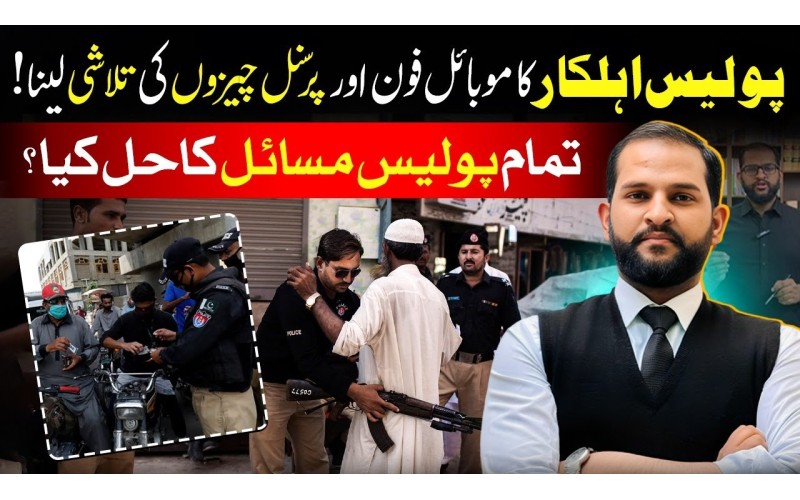
In recent years, students and ordinary citizens across Pakistan have increasingly reported a troubling practice at police checkpoints: after stopping individuals and checking their ID cards, some police officers proceed to search personal mobile phones. WhatsApp messages are opened, private photos are viewed, and social media accounts are browsed, often without consent, explanation, or any legal justification.
This raises an important question: Is this legal? And if not, how should a citizen deal with it, calmly, safely, and without escalating the situation?
What the Law Actually Allows
Under Pakistani law, police officers do have the authority to stop individuals at checkpoints and conduct a personal search under specific circumstances. This may include checking for weapons or illegal items where reasonable suspicion exists.
However, a mobile phone is not an ordinary physical object. It contains deeply personal data, private conversations, images, financial details, and digital records. Accessing this information falls under the realm of privacy, which is protected by the Constitution of Pakistan.
Article 14 of the Constitution clearly states that the dignity of man and the privacy of home, and by extension personal life, shall be inviolable. Arbitrary access to a citizen’s phone violates this fundamental right.
Unless police are investigating a specific electronic crime and have proper legal authorization, they cannot legally demand access to your phone, nor can they scroll through your private data at a checkpoint.
Forced Mobile Searches Amount to Misconduct
When a police officer checks your phone without lawful authority, it may amount to misconduct or abuse of power. Under relevant provisions of the Pakistan Penal Code and Code of Criminal Procedure, such actions can expose an officer to criminal liability.
In certain cases, police misconduct may be:
- Cognizable (action can be taken without court permission)
- Non-bailable
- Punishable with imprisonment of up to three years
A citizen may:
- File an FIR if evidence is available
- File a private complaint before a magistrate if the police refuse to register a case
- Proceed under criminal complaint procedures even without eyewitnesses, as the victim’s testimony can be sufficient
That said, the legal route comes with real-world costs, lawyer fees, court appearances, emotional stress, and possible backlash.
The Reality on the Ground: Why People Stay Silent
While the law may be on the citizen’s side, the reality is more complex.
Most students and working individuals do not want:
- Long court battles
- Financial burden
- Disruption of education or work
- Hostility from local police officials
There is also a genuine fear that if someone resists or later files a complaint, they may be falsely implicated in other cases. This fear, whether justified or not, prevents many victims from asserting their rights.
How to Handle the Situation at the Spot
If you are stopped at a checkpoint and asked to hand over your phone:
- Stay calm and respectful
Escalation helps no one. Do not argue aggressively. - Politely ask for the legal basis
You may say:
“Sir, may I know under which law my phone is being checked?” - Do not unlock your phone voluntarily
Handing over an unlocked phone can be interpreted as consent. - Avoid confrontation
If the situation feels unsafe, prioritize your security over legal arguments. - Remember details
Note the location, time, officer’s name or badge number if possible.
Sometimes, discretion is the wiser choice in the moment. Legal remedies can always be explored later.
The Long-Term Solution: Accountability Through Body Cameras
The most effective and practical solution is institutional accountability, not individual confrontation.
International policing standards increasingly rely on body-worn cameras. When officers are required to record interactions:
- Abuse of power decreases
- False allegations reduce
- Citizens feel safer
- Police officers themselves are protected from baseless complaints
If billions can be spent on infrastructure and cosmetic upgrades, investing in body cameras is neither unrealistic nor excessive. A single camera can prevent countless violations and rebuild public trust.
Conclusion
The unchecked search of mobile phones at checkpoints is not just a legal issue, it is a matter of dignity, privacy, and trust between the state and its citizens.
While the law provides remedies, the true solution lies in systemic reform, clear standard operating procedures, and transparency. Until then, awareness remains the first line of defense.
An informed citizenry is not a threat to law enforcement, it is its strongest ally.