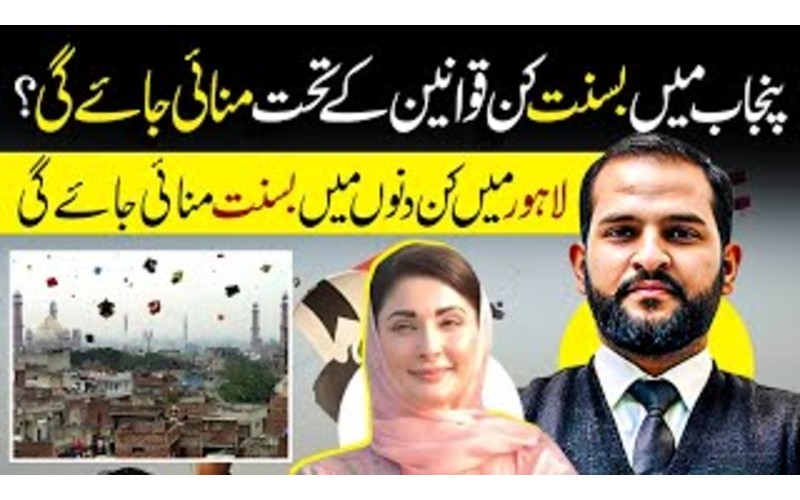
After nearly eighteen years, the Government of Punjab has decided to legally revive Basant, the traditional kite-flying festival, in February 2026. The announcement has sparked widespread debate across the province. While many view it as a cultural revival, others question whether reopening this chapter is legally, socially, and ethically justified.
To regulate the event, the Punjab Government has started issuing official notifications, including directives from Deputy Commissioners. These notifications lay down strict rules and regulations aimed at preventing the tragedies that previously led to Basant’s ban.
This blog examines the key regulations, the government’s rationale, and the legal questions that arise from this decision.
What the Government Notifications Say
According to official notifications, Basant will be celebrated on 6th, 7th, and 8th February 2026, but only in areas specifically allowed through government approval.
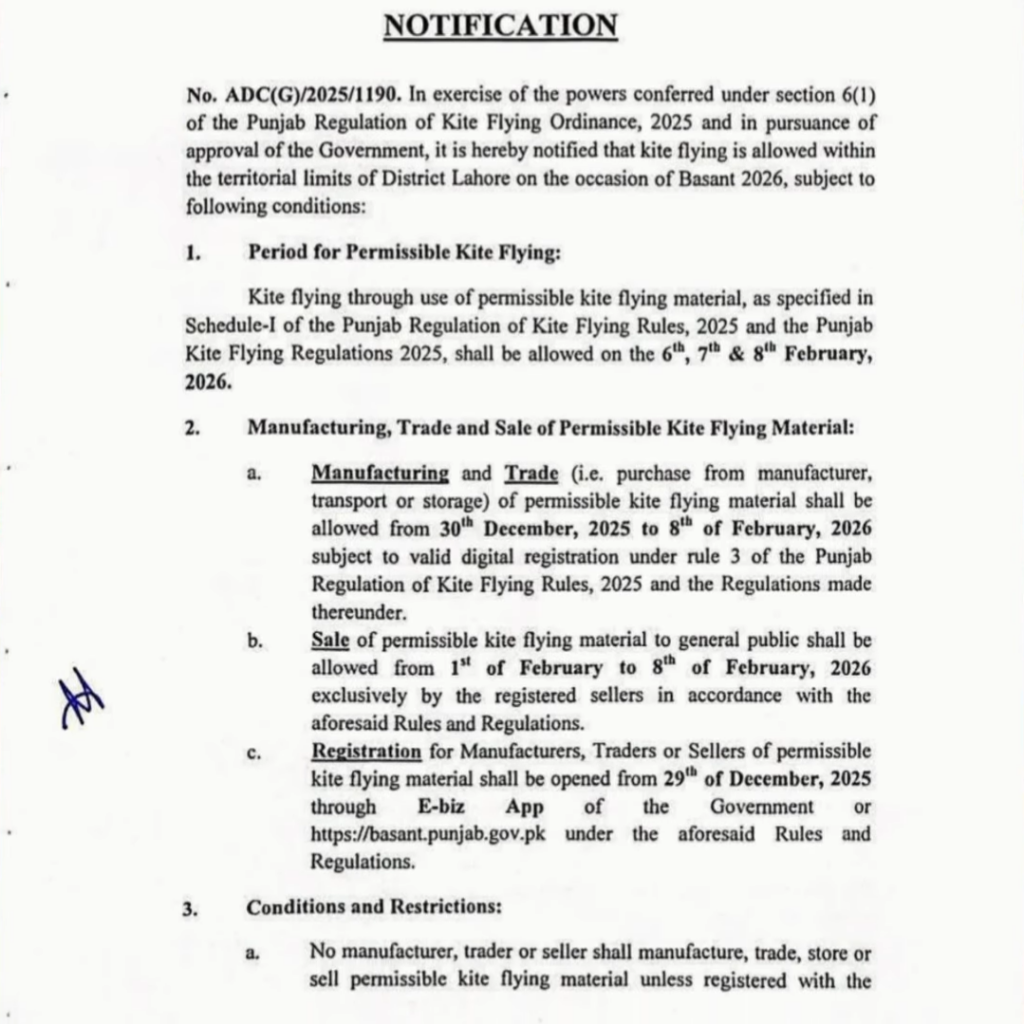
Notification
1. Registration of Manufacturers and Traders
For the first time, kite-related business activities will be restricted to registered entities only.
- Only registered manufacturers and traders will be allowed to:
- Manufacture kites, thread (dor), and spools (gudda)
- Trade and sell these items
- Manufacture kites, thread (dor), and spools (gudda)
- Applications must be submitted to the DC Office.
- Manufacturing and trading will be permitted from 30 December 2025 to 8 February 2026.
Unregistered manufacturing or selling will be illegal.
2. Restrictions on Public Purchase
The general public will not be allowed to buy kites freely for months.
- Kite purchases by the public will be allowed only from 1st February to 8th February 2026
- This effectively limits kite flying to a short, controlled window
3. Size Limitations on Kites and Spools
Strict size specifications have been introduced:
- Gudda (spool) must not exceed 30 x 30 cm
- Kite size must not exceed 4.5 gits
- Large, oversized kites (commonly linked to accidents in the past) are strictly prohibited
4. Regulation of Kite Thread (Dor)
The most dangerous element of Basant, chemical or glass-coated string, has been heavily regulated.
- Dor must consist of nine threads
- Thread count, material composition, and coating substances are strictly defined
- Use of harmful glass or metal-infused material is regulated under law
Any violation can lead to criminal liability.
5. Traffic and Safety Measures
Public safety measures have also been included:
- Motorcyclists are prohibited from exceeding 60 km/h
- This rule is aimed at reducing fatal accidents caused by kite strings
The Core Legal Question
The central question remains:
Should kite flying be allowed again after 18 years of prohibition?
The ban was originally imposed due to:
- Fatal accidents caused by sharp kite strings
- Severe injuries to pedestrians and motorcyclists
- Loss of life that raised constitutional concerns regarding the right to life and public safety
Now, despite strict regulations, critics argue that:
- Enforcement has historically been weak
- Monitoring thousands of rooftops is practically impossible
- Even one fatal incident could raise constitutional and legal challenges
Is Public Interest Litigation an Option?
From a legal perspective, the revival of Basant raises an important question:
Should a Public Interest Litigation (PIL) be filed?
A PIL could challenge:
- Whether the government has fulfilled its constitutional duty to protect life
- Whether regulatory mechanisms are realistically enforceable
- Whether cultural celebration outweighs potential public harm
Courts in the past have taken a strict view on Basant-related risks. Any lapse in enforcement could invite judicial scrutiny once again.
Cultural Celebration vs Constitutional Responsibility
There is no doubt that Basant is deeply rooted in Punjab’s cultural identity. However, culture cannot exist in isolation from constitutional responsibility.
The success or failure of Basant 2026 will depend entirely on:
- Strict enforcement
- Zero tolerance for violations
- Accountability at administrative levels
Without this, history may repeat itself.
Final Thoughts
Basant’s legal return is not merely a festival, it is a legal experiment. Whether it becomes a model for regulated cultural revival or another cautionary tale will be determined not by notifications, but by enforcement on the ground. The debate is open.
Should Basant be allowed again, or should public safety prevail over tradition?
Your opinion matters.