
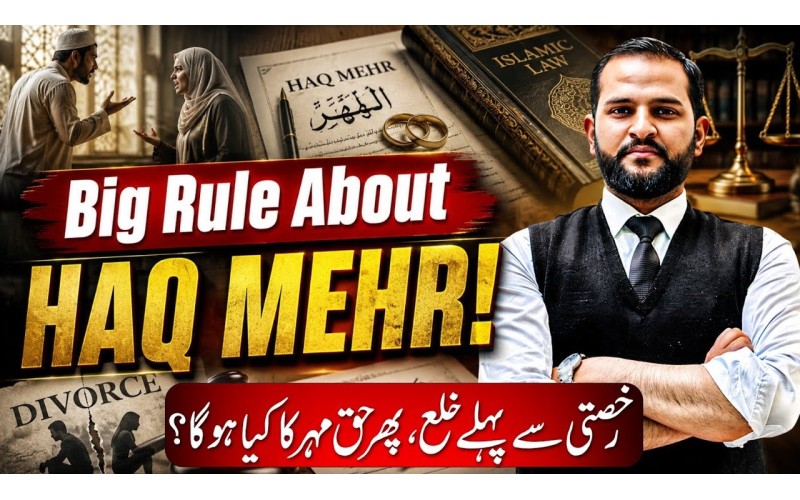
A common misconception is that if a wife files for Khula before Rukhsati or before the marriage is consummated, she automatically loses her right to Haq Mehr (Dower). However, the law is far more nuanced.
Recent judicial interpretations of the Muslim Family Laws Ordinance, 1961 and the West Pakistan Family Courts Act, 1964 clarify that, in many circumstances, a husband may still be legally obligated to pay a substantial portion of the agreed Haq Mehr, even where the spouses never lived together or consummated the marriage.
Divorce by Husband vs. Khula by Wife
The legal consequences differ depending on how the marriage ends.
If the husband pronounces divorce (Talaq) after Nikah, he may remain liable to pay the agreed Haq Mehr in accordance with the terms of the marriage contract and the applicable law.
However, where the wife seeks dissolution of marriage through Khula, different legal provisions apply.
What Happens if Khula Is Filed Before Rukhsati?
Suppose:
- The Nikah has taken place.
- Rukhsati has not yet occurred.
- The marriage has not been consummated.
- A substantial amount has been fixed as Haq Mehr in the Nikahnama.
Even in these circumstances, if the wife files for Khula, the husband may still be required to pay a significant portion of the Haq Mehr under the applicable legal provisions.
Importance of Mu’ajjal and Ghair Mu’ajjal Haq Mehr
The Nikahnama distinguishes between two types of Haq Mehr:
- Mu’ajjal (Prompt Dower): Payable immediately.
- Ghair Mu’ajjal (Deferred Dower): Payable at a later stage as agreed by the parties.
Many people simply write a large amount as deferred dower without clearly specifying when or under what conditions it becomes payable.
This can create serious legal consequences.
Section 10 of the Muslim Family Laws Ordinance, 1961
Section 10 provides that where the Nikahnama does not clearly specify the time for payment of deferred dower, the deferred amount is presumed to be payable on demand.
In other words, if the marriage contract merely states that the dower is deferred but does not mention the payment schedule, the law may treat it as immediately recoverable when demanded.
Therefore, it is extremely important to clearly record:
- Whether the dower is prompt or deferred.
- The exact amount of each.
- The date or event upon which deferred dower becomes payable.
- Whether payment is linked to Rukhsati, a specified number of years, divorce, or any other agreed condition.
- If immovable property forms part of the dower, its complete description and the conditions of transfer should also be clearly stated.
Effect of Khula Under Family Law
Under the relevant provisions of the West Pakistan Family Courts Act, 1964, courts have held that when a wife obtains Khula, she may still retain a prescribed portion of the Haq Mehr depending upon the nature of the dower.
Judicial interpretation has recognized that:
- A wife may retain 75% of the Mu’ajjal (prompt) Haq Mehr.
- She may also retain 50% of the Ghair Mu’ajjal (deferred) Haq Mehr, subject to the applicable legal provisions and the facts of each case.
This means that even where there has been no Rukhsati and no consummation of the marriage, the husband may still remain liable for a substantial part of the agreed dower.
Pay Special Attention to Columns 14, 15 and 16 of the Nikahnama
Many legal disputes arise because parties complete the Nikahnama without understanding its contents.
The following columns are particularly important:
- Column 14: Specifies whether the Haq Mehr is prompt (Mu’ajjal) or deferred (Ghair Mu’ajjal).
- Column 15: Records how much prompt dower has already been paid.
- Column 16: States the details of deferred dower, including the property, amount, conditions, and the time when it becomes payable.
These columns should never be left vague or incomplete.
Pending Supreme Court Proceedings
A judgment of the Federal Constitutional Court has also addressed the issue of payment of Haq Mehr after a wife obtains Khula. However, that decision has reportedly been challenged before the Supreme Court of Pakistan.
The Supreme Court’s eventual ruling is expected to further clarify the legal position on this important question.
Conclusion
The assumption that no Haq Mehr is payable simply because Rukhsati or consummation never took place is not always legally correct.
Where the Nikahnama has been drafted without clearly defining the terms of deferred dower, the law may presume that it is payable on demand. Furthermore, depending upon the circumstances and the applicable statutory provisions, a wife who obtains Khula may still retain a significant portion of the agreed Haq Mehr.
For this reason, every couple should carefully complete the Nikahnama, particularly the provisions relating to Haq Mehr, to avoid future legal disputes and unintended financial consequences.