
If your client, friend, or relative is behind bars, then understanding bail law can make a tremendous difference. There is a remarkable judgment of the Supreme Court of Pakistan that every lawyer, law student, and ordinary citizen should read carefully.
The judgment is PLD 1995 Supreme Court 34 – Tariq Bashir vs The State. This case dealt with the cancellation and grant of bail, but more importantly, the Honourable Supreme Court laid down principles that are still followed by Pakistani courts today.
Two Types of Offences in Bail Law
Under Pakistani criminal law, offences are generally divided into two categories:
1. Bailable Offences
In bailable offences, bail is considered a matter of right. The accused person must be granted bail.
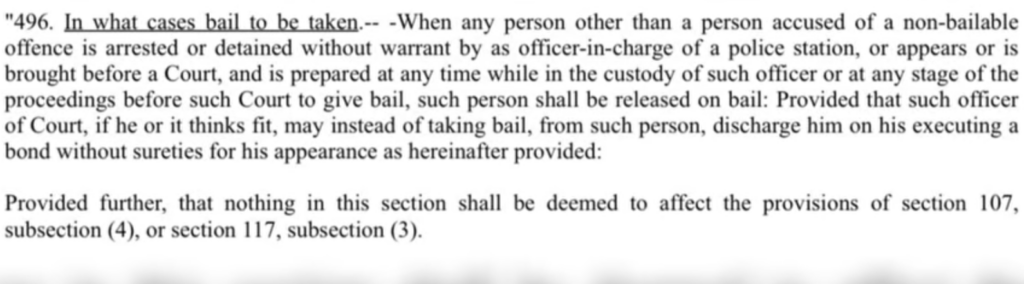
Section 496 of the Criminal Procedure Code explains that when a person accused of a bailable offence appears before a Magistrate or Court, the court can release that person on bail. In some cases, the Magistrate may even release the accused on personal surety.
Personal surety means that if the accused cannot arrange a guarantor, furnish bail bonds, or deposit surety money, the court may still release him instead of sending him behind bars for a minor offence.
2. Non-Bailable Offences
Non-bailable offences are those in which the law states that bail is not automatically available. However, this does not mean that bail can never be granted.
For understanding non-bailable offences, Section 497 Cr.P.C. is extremely important, especially subsection (1) and subsection (2).
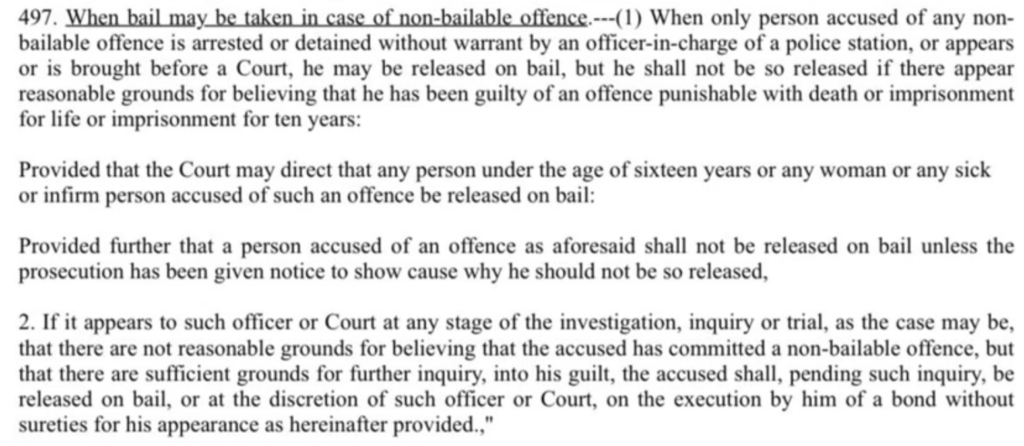
The law further divides non-bailable offences into two categories:
Prohibitory Clause Cases
These are offences where the punishment is:
- 10 years imprisonment or more,
- Life imprisonment, or
- Death penalty.
Generally, bail is not granted in such cases. However, even in these offences, the court may grant bail if the matter requires further inquiry or if there is reasonable doubt regarding the prosecution story.
At the bail stage, the court conducts only a tentative assessment of the evidence without going into deeper appreciation of facts.
Non-Prohibitory Clause Cases
These are offences where the punishment is less than 10 years imprisonment.
In such cases, bail is normally granted, even though the offence may technically be non-bailable. The refusal of bail in these matters should only happen in exceptional circumstances.
The courts have repeatedly held that in non-prohibitory offences, liberty is the rule and jail is the exception.
Principle of Further Inquiry
One of the most important principles discussed in the Tariq Bashir case is “further inquiry.”
If the facts and circumstances of the case create reasonable doubt in the mind of the court, then the accused becomes entitled to bail. Even at the bail stage, if the judge notices weaknesses, contradictions, or uncertainty in the prosecution case, bail may be granted without conducting a full trial.
The Supreme Court clarified that courts should avoid deep appreciation of evidence while deciding bail applications. A tentative assessment is sufficient.
Power of Courts While Granting Bail
Another important aspect of this judgment is that the Supreme Court not only granted bail but also directed the trial court to conclude the trial within six months.
This shows that courts possess the authority to:
- Grant bail in extraordinary circumstances,
- Consider reasonable doubt and further inquiry,
- Protect the liberty of the accused, and
- Ensure speedy trial proceedings.
Why This Judgment Is Important
The judgment in PLD 1995 SC 34 – Tariq Bashir vs The State remains one of the foundational authorities on bail law in Pakistan. Even today, lawyers frequently rely upon it during bail arguments before Magistrates, Sessions Courts, High Courts, and the Supreme Court.
Anyone dealing with criminal litigation, especially matters involving bail, should read this judgment in full to understand how Pakistani courts interpret liberty, reasonable doubt, and further inquiry in criminal cases.