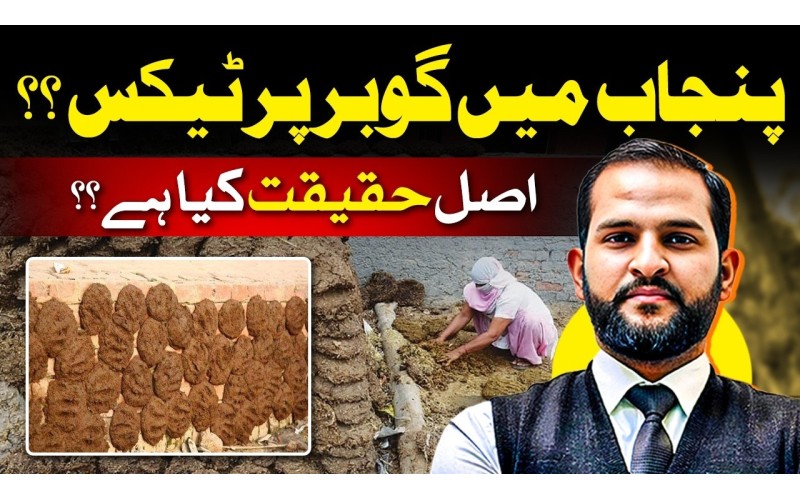
Recently, news about a so-called “Gobbar Tax” (cow dung tax) in Punjab has been circulating widely on social media. Memes, debates, and public concern have followed. At the same time, government officials, including the concerned minister, have denied that any such tax has officially been imposed.
This raises an important question:
What exactly is this “Gobbar Tax,” and is there any truth behind it?
Background: The “Suthra Punjab Ordinance 2025”
Under the proposed Suthra Punjab Ordinance 2025, a new authority, Suthra Punjab Authority, has been established. This authority has been granted wide-ranging powers to:
- Manage waste across Punjab
- Regulate sanitation systems
- Collect charges related to waste collection and disposal
In principle, the goal is to improve cleanliness and waste management across the province.
Existing Financial Burden on Citizens
Currently, residents in Punjab are already paying multiple charges, including:
- WASA bills, which include sanitation charges
- Payments to private waste collectors, who often refuse to collect garbage if not paid separately
Despite these existing costs, people are now hearing about additional charges related to waste management, raising concerns about double taxation.
What Is the Proposed “Gobbar Tax”?
According to circulating reports, the proposal suggests that:
- Cattle farmers may be charged around Rs. 30 per animal per day for the collection of dung (waste).
- This amounts to approximately Rs. 11,000 annually per animal.
Under this idea:
- The government would collect the dung
- Use it to produce biogas and electricity
- Potentially generate profit from it
However, the concern is that:
👉 Farmers would not only lose ownership of a resource (dung) that they can use for fertilizer,
👉 But would also have to pay a tax for its collection.
Why This Is Controversial
This proposal has sparked criticism for several reasons:
- Economic burden on farmers: Farmers already contribute significantly to Pakistan’s economy, and additional taxes may push them further into financial stress.
- Loss of ownership: Cow dung is traditionally used by farmers for agricultural purposes, such as fertilizing fields.
- Double or multiple taxation: Farmers and citizens already pay various sanitation-related charges.
- Unequal benefit: The government may profit from biogas and electricity production, while farmers bear the cost.
Contradictions and Government Response
The relevant minister has publicly denied the existence of such a tax, creating confusion:
- Is this policy still under consideration?
- Is it being misunderstood or misrepresented?
- Or is it an early proposal facing public backlash?
Until there is clear communication, uncertainty remains among the public.
A Bigger Concern: Pressure on the Agricultural Sector
Pakistan is fundamentally an agricultural country, and farmers play a critical role in sustaining the economy.
If additional financial pressures continue to be placed on farmers:
- Agricultural productivity may decline
- Rural livelihoods may suffer
- The broader economy could face long-term consequences
Conclusion
The debate around the so-called “Gobbar Tax” highlights a deeper issue, growing public concern over increasing taxes and financial pressure.
Whether this specific tax exists or not, one thing is clear:
People, especially farmers, are already under significant economic strain.
Any new policy must ensure:
- Fairness
- Transparency
- And protection of those who are the backbone of the economy
Without careful planning, such measures risk doing more harm than good.