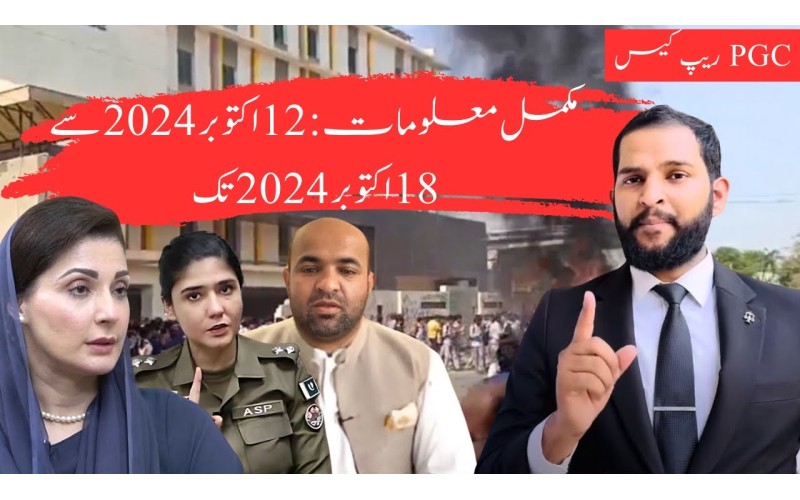
In October 2024, a serious controversy erupted involving an alleged rape incident at Punjab College (PGC) Gulberg Campus. What began as information circulating in private social media groups quickly escalated into province-wide protests, legal petitions, FIRs, and widespread public confusion.
This article presents a structured timeline of events, legal developments, and the major concerns raised regarding the handling of the situation.
How the News Spread
October 12, 2024
Information about an alleged rape incident began circulating in a few social media groups, including internal PGC groups.
October 13, 2024
The news spread widely. Social media influencers, journalists, and activists began discussing the matter publicly. Influencers released videos condemning the alleged incident and questioning:
- Why had no FIR been registered?
- Why had no suspects been arrested?
- Was the matter being mishandled?
On the night of October 13, some police officers reportedly contacted individuals asking:
- Who is the alleged victim?
- Where is she?
- Who are her parents?
- Why has no formal complaint been filed?
Police expressed willingness to register an FIR if a formal complaint was submitted.
Student Protests & Alleged Mismanagement
October 14, 2024 – Large-Scale Protest
Students gathered at PGC Gulberg Campus in large numbers to protest.
Critics argue that instead of engaging student representatives and facilitating dialogue with the alleged victim’s family, the administration allegedly:
- Pressured students
- Questioned them about social media posts
- Attempted to suppress protest activity
As tensions escalated:
- Students reportedly attempted to enter blocked areas
- Gates were damaged
- Police responded with baton charges and tear gas
- Several students were allegedly injured
- Arrests were made
A controversial remark by a police official reportedly further angered students, escalating the situation.
Legal Action: Habeas Corpus Petition
On October 14, a Habeas Corpus Petition under Article 199 was filed in court.
The petition requested:
- Recovery of the alleged victim
- Production of the girl in court
- Recording of her statement
- Clarification to calm public unrest
The legal argument was simple:
If the alleged victim appeared before court and stated that no crime occurred, the matter would be resolved. If she confirmed wrongdoing, legal action should proceed accordingly.
However, critics claim no immediate verification was conducted at the hospitals where she was allegedly treated.
The case was fixed for hearing on October 16, 2024.
Government & Institutional Responses
Several actions added to public confusion:
- The Provincial Education Minister reportedly gave a statement suggesting the incident appeared to have occurred.
- The Directorate of Public Instruction Colleges suspended the registration of Punjab College Gulberg Campus.
- A Fact-Finding Committee was formed with a 48-hour reporting deadline.
However:
- The official report was not publicly released.
- The committee reportedly met 36 individuals, including college staff and police officials
- It concluded that the girl had fallen from a bed on October 2 and suffered injuries.
- She was reportedly treated at General Hospital and later Ittefaq Hospital.
- It was stated she had respiratory complications and was admitted to ICU.
- The family had applied for leave from October 2 to October 15.
These explanations raised further public questions about the medical narrative and timeline.
Conflicting FIRs & Statements
On October 16, 2024, two major FIRs were registered:
1. Punjab Police FIR
Filed at Defense Police Station.
The investigating officer claimed:
- He met the girl and her parents.
- They denied any rape incident.
- False information was being spread.
Sections related to false information were applied.
2. FIA Cyber Crime FIR
Filed the same day.
However, in this complaint, the college principal reportedly stated:
“We have been trying to find the girl and her family with the help of Punjab Police, but so far we have not found them.”
This contradiction intensified public suspicion:
- If police had already met the girl and family,
- How was the principal claiming the victim had not been found?
Arrests, Charges & Political Angle
By mid-October:
- Student protests spread across Punjab.
- Numerous arrests were made.
- Cases were registered against students and journalists.
- Some protesters were reportedly subjected to force.
In one case, a lawyer was discharged after the magistrate observed signs of political victimization.
Critics argue the matter was politicized at multiple levels.
Core Legal Position
The central legal argument remains:
- If the alleged victim and her parents do not come forward,
- If no formal complaint is filed,
- The case cannot legally proceed as a rape prosecution.
Until the alleged victim appears in court or files a statement, spreading unverified claims may constitute dissemination of false information.
The court has summoned relevant officials to clarify contradictions.
Lessons From the Incident
This episode highlights several critical issues:
- The speed of social media amplification.
- Institutional communication failures.
- Lack of coordinated crisis management.
- Public trust erosion due to conflicting statements.
- The need for verification before sharing sensitive allegations.
Message to Parents & Students
Some parents reportedly withdrew their daughters from colleges out of fear.
Legal experts advise:
- Educational institutions remain essential for growth and protection.
- Avoid panic-driven decisions based solely on social media narratives.
- Verify information before reacting.
- Encourage daughters to continue their education.
Safety concerns must be addressed, but education should not be halted without verified evidence.
Conclusion
Whether the incident was real, exaggerated, or entirely false remains a matter for judicial clarification.
However, one fact is clear:
This controversy exposed serious communication gaps, contradictory official statements, and widespread public mistrust.
The case stands as a reminder that:
- Allegations must be verified.
- Institutions must respond transparently.
- Authorities must avoid contradictory messaging.
- Social media users must exercise responsibility.
The court proceedings will ultimately determine the truth. Until then, responsible discourse is essential.