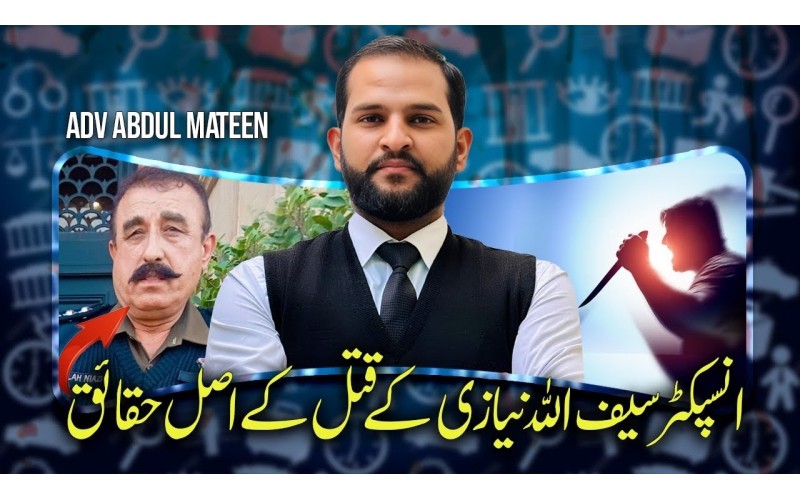
A recent tragic incident has sparked intense public debate across the country. A police inspector was shot and killed by a civilian, Adil. Social media quickly divided into two camps ,some attempting to socially justify the act due to alleged verbal abuse, and others demanding the harshest possible punishment.
But as a society governed by law, we must clearly distinguish between social emotion and legal responsibility.
Legal Justification vs. Social Justification
There are two types of justification:
- Legal justification
- Social justification
Certain acts may be socially understandable yet legally indefensible. For example, divorce may be legally valid but socially criticized. Similarly, feeling insulted or abused does not legally justify taking someone’s life.
No matter how intense the anger, murder cannot be legally justified.
If we begin to legally justify violence based on emotion, we move toward anarchy.
The Legal Framework: Section 302
Under Pakistani criminal law, intentional murder falls under Section 302 of the Pakistan Penal Code. The possible punishments include:
- Death penalty (Qisas)
- Life imprisonment
- Other penalties depending on judicial findings
In this case, the act appears intentional. The accused allegedly fired the weapon himself. Therefore, Section 302 would apply.
However, courts also examine mitigating circumstances before determining the final sentence.
Extreme Provocation and Mitigating Circumstances
Reports suggest:
- The incident happened suddenly.
- There was verbal confrontation.
- The act was committed in a state of extreme anger.
- The accused reportedly called emergency services himself.
- He was apprehended at the scene.
Sudden and grave provocation does not excuse murder. However, it may influence sentencing. Courts sometimes convert a potential death sentence into life imprisonment if the act occurred under extreme emotional disturbance rather than premeditated planning.
This does not make the act lawful. It only affects punishment.
The Fear of Police Encounter Killings
The family has expressed concern about the possibility of a staged police encounter.
In 2022, Pakistan introduced legislation to address custodial torture and deaths, aiming to restrict fake encounters and ensure independent investigations in cases of custodial harm.
If:
- The accused was arrested at the scene,
- Video evidence exists,
- Call records are available,
Then transparency becomes crucial. Any custodial harm would invite serious legal consequences.
The law must protect both victims and accused persons.
A Larger Institutional Question
This case has also highlighted deeper concerns:
- Allegations of false FIR registrations
- Abuse of power by officials
- Custodial torture
- Lack of accountability within police structures
When institutions fail to ensure accountability, public frustration builds. That frustration, if unchecked, can explode into violence.
But frustration is not a legal defense for murder.
At the same time, abuse of authority must not go unpunished.
Justice requires balance.
A Dangerous Social Media Narrative
Some voices online are saying: “He did the right thing.”
This mindset is deeply dangerous.
If verbal abuse becomes justification for killing, society collapses into lawlessness. Every argument could turn fatal. The rule of law would disappear.
Crime must remain crime, regardless of who commits it.
If a police officer abuses power, he must face accountability.
If a civilian commits murder, he must also face accountability.
Selective justice is no justice at all.
The Role of Courts
This matter will now proceed through the judicial process:
- Evidence will be examined.
- Witnesses will testify.
- Motive and provocation will be assessed.
- Mitigating circumstances may be argued.
Courts exist to provide free and fair trials, not emotional verdicts.
Justice must be delivered through institutions, not through anger or revenge.
A Message to Law Enforcement
Authority comes with responsibility.
If officers:
- Habitually use abusive language,
- Register false cases,
- Engage in torture,
- Act without accountability,
Public trust erodes.
Professional conduct is not optional, it is essential for legitimacy.
Final Thoughts
This tragic incident is a reminder of two realities:
- Murder can never be legally justified.
- Abuse of power can never be ignored.
For society to function, both unlawful violence by citizens and unlawful conduct by authorities must be punished equally under the law.
Only then can justice prevail, not emotion, not revenge, but law.