
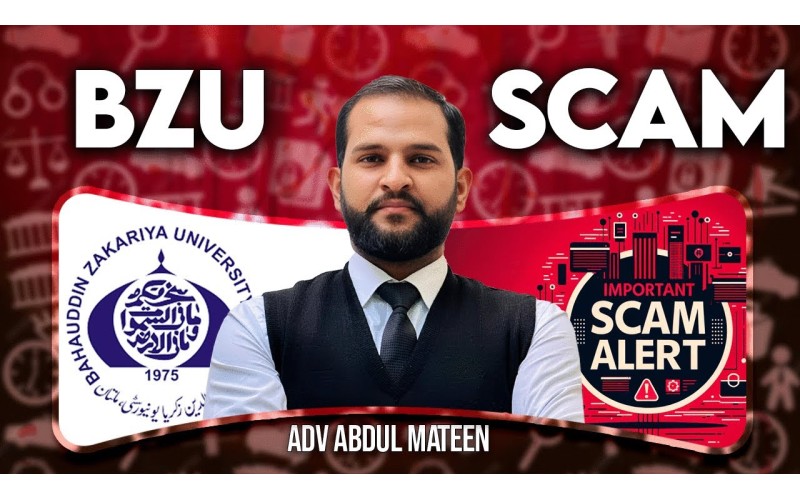
For the past seven years, hundreds of law students in South Punjab have been suffering due to administrative corruption and regulatory failure. This is not just a bureaucratic delay, it is a complete breakdown of academic responsibility that has destroyed careers, delayed professional licenses, and shattered lives.
At the center of this crisis is Bahauddin Zakariya University (BZU), Bahawalpur, once considered a respected public institution, now widely criticized over one of the most damaging academic scandals in Pakistan’s recent history.
Background: The Shift from 3-Year to 5-Year LL.B
In 2018, a nationwide policy was implemented across Pakistan requiring that the LL.B degree be converted from a 3-year graduate program to a 5-year program after Intermediate (F.A/F.Sc/I.Com/ICS). This reform aimed to standardize legal education and improve professional quality.
Under the new system:
- Students were required to enroll directly after Intermediate.
- The 3-year LL.B program was discontinued.
- No university was permitted to offer fresh admissions in the old 3-year structure.
The reform was overseen by the Pakistan Bar Council, the statutory body responsible for regulating legal education and the legal profession.
The Alleged 3-Year LL.B Scam (2018–2019)
Despite the 2018 ban, reports emerged that BZU continued offering admissions into the discontinued 3-year LL.B program during 2019.
The alleged mechanism involved:
- Backdated enrollments (showing students admitted in 2018 instead of 2019)
- Supplementary examination arrangements
- Financial transactions between affiliated law colleges and university officials
- Payments allegedly made to regulatory authorities to maintain silence
Later investigations, including inquiries by the Federal Investigation Agency (FIA), reportedly revealed involvement at multiple administrative levels, including:
- Vice Chancellor
- Controller of Examinations
- Heads of Department
- Principals of affiliated law colleges
- Registrar’s office
Additionally, around 26 affiliated colleges were reportedly declared “ghost colleges”. institutions allegedly operating without proper recognition or authorization.
When regulatory payments allegedly stopped, the matter was exposed and became public.
The Real Victims: 5-Year LL.B Students
While the 3-year program controversy gained attention, the most tragic aspect of this case is often overlooked.
Students who enrolled in the legitimate 5-year LL.B program, fully compliant with national regulations,are also suffering.
These students:
- Took admission through BZU or its affiliated colleges.
- Completed yearly examinations.
- Filed petitions in the High Court when exams were delayed.
- Continued their studies in good faith.
Yet, even after 5 years:
- Their results have not been properly declared.
- Their degrees have not been issued.
- They cannot obtain bar licenses.
- They cannot begin legal practice.
They were not part of any scam. Their only “mistake” was trusting a public university.
Supreme Court Directions Ignored
The Supreme Court of Pakistan reportedly issued directions suggesting:
- Establishment of study centers
- Continuation of annual examinations
- Protection of innocent students
- Issuance of results and degrees to those not involved in irregularities
Despite these directions, implementation has reportedly stalled. For five years, many students remain in academic limbo.
Human Cost of Administrative Failure
This is no longer just an education dispute.
The consequences include:
- Lost professional years
- Age-limit disqualifications for government jobs
- Financial hardship
- Severe psychological stress
- Reports of extreme mental health crises among affected students
A law degree is not just a certificate, it is a pathway to livelihood, dignity, and service to society. Denying it without fault is institutional injustice.
Questions That Demand Answers
- Why are innocent 5-year LL.B students being punished for administrative corruption?
- Why have Supreme Court directions not been fully implemented?
- Why has regulatory oversight failed to provide timely relief?
- Who will compensate students for seven years of lost professional life?
Call for Immediate Action
We urge:
- The Government of Punjab to initiate immediate administrative action.
- The Pakistan Bar Council to conduct an independent review.
- Accountability proceedings against officials involved in malpractice.
- Immediate declaration of results and issuance of degrees for legitimate students.
- Creation of functioning study centers where required.
Justice delayed is justice denied.
These students enrolled to study law, not to become victims of lawlessness.
Final Words
The integrity of legal education defines the integrity of the legal system itself. If future lawyers are denied justice at the doors of their own universities, what message does that send about the rule of law?
Seven years is too long.
It is time for resolution. It is time for accountability. It is time for justice.