
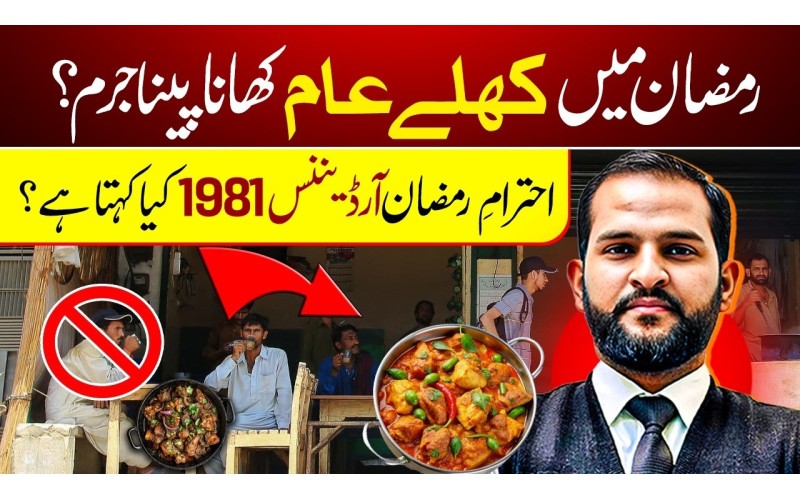
As Ramadan begins, many people ask an important legal question:
What is the law in Pakistan regarding eating, drinking, or smoking in public during fasting hours?
This discussion relates to the Ehtram-e-Ramazan Ordinance, 1981, enacted on 25 June 1981 during the era of Muhammad Zia-ul-Haq.
What Does the Ehtram-e-Ramazan Ordinance Say?
The Ehtram-e-Ramazan Ordinance was introduced to ensure respect for the sanctity of Ramadan in public spaces.
Under this law:
- Eating, drinking, or smoking in public places during fasting hours is prohibited.
- Violators may face up to three months’ imprisonment, a fine, or both.
- Restaurants, hotels, and similar establishments are not allowed to serve food openly in public during fasting hours.
- Managers or owners who violate the law may also face penalties.
The Ordinance consists of multiple sections. One important provision states that cinemas and theaters cannot remain open during fasting hours and may only open three hours after sunset (after Iftar). Opening earlier may result in penalties and fines.
In 2017, the Punjab Government introduced amendments increasing the amount of fines under this law. Despite criticism and debate over the years, the law remains in force today.
Can an FIR Be Registered Under This Law?
A very important clarification:
An FIR (First Information Report) is generally not directly registered under this Ordinance in the same way as other criminal offenses.
However:
- If a person is seen eating, drinking, or smoking in a public place during fasting hours, evidence may be collected.
- A complaint can be prepared and submitted before a Magistrate.
- The Magistrate may then proceed with the case and impose punishment if deemed appropriate.
So while immediate arrest with a standard FIR is not the usual procedure, legal consequences are still possible through a complaint before the court.
Important Exceptions
The law does provide practical exceptions. It does not apply to:
- Hospitals
- Children who are not obligated to fast
- Non-Muslims
- Travelers (for example, passengers on trains)
- Other individuals who are religiously exempt from fasting
Arrangements may be made in certain places to accommodate such individuals.
Restaurants and Hotels Today
Many restaurants and hotels continue operations during Ramadan by:
- Providing takeaway or delivery services
- Using curtains or partitions to create private spaces
While there is no clearly defined statutory framework for these arrangements, authorities often adopt a policy of non-interference where the sanctity of Ramadan is maintained publicly.
A Message at the Start of Ramadan
As Ramadan begins, it is important to understand both the religious and legal dimensions of respecting the holy month.
Citizens should be aware of their rights, responsibilities, and the possible legal implications of public conduct during fasting hours.
Ramadan Mubarak to everyone.