
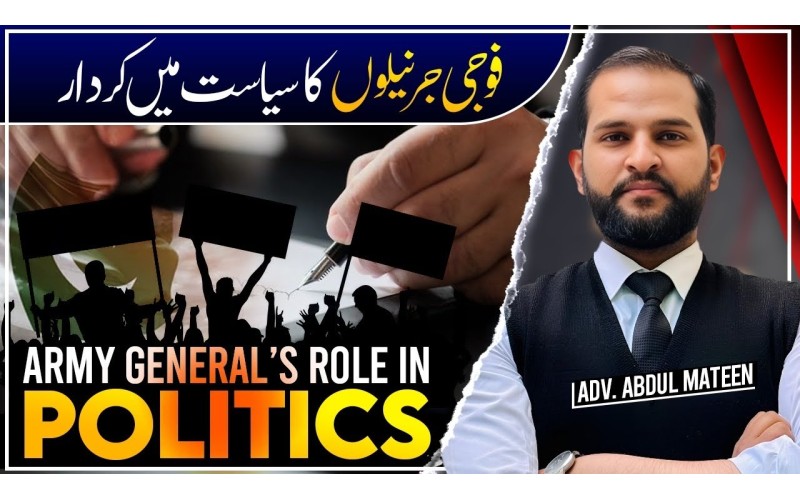
Pakistan became independent on 14 August 1947. The country held its first general elections in 1954, and its first Constitution was enacted in 1956. However, just two years after the Constitution was formed, martial law was imposed. General Ayub Khan took power, and for the next 13 years, the country remained under military rule.
During this period, the 1962 Constitution was introduced, but it did not survive. After years of authoritarian rule, general elections were finally held in 1971. On one side was Zulfikar Ali Bhutto, and on the other was Sheikh Mujibur Rahman. Despite Sheikh Mujibur Rahman’s electoral victory, power was not transferred to him. The result was catastrophic: East Pakistan separated and became Bangladesh, leaving the remaining state as present-day Pakistan.
In 1973, Pakistan adopted its third Constitution. Yet, only four years later, in 1977, martial law was imposed again. Zulfikar Ali Bhutto was executed, and General Zia-ul-Haq ruled the country for 11 years. After his death in 1988, elections resumed.
Over the following years, power alternated between the Pakistan Peoples Party (PPP), Islami Jamhoori Ittehad (IJI), and Pakistan Muslim League (N). However, in 1999, another military takeover occurred, and General Pervez Musharraf ruled until 2008 under another form of authoritarian control.
Out of Pakistan’s 78 years of existence, approximately 33 years have been under direct military rule. Even during the remaining 45 years of civilian governments, military influence has played a decisive role in forming and dismissing governments.
Defense Priorities vs. National Outcomes
The primary responsibility of any military is national defense. In Pakistan’s case, this included defending the country, addressing the Kashmir issue, and supporting causes such as Palestine. Over the decades, major military housing schemes and business enterprises were developed, including DHA, cantonments, Askari schemes, Askari banks, Army Welfare Trust, and Fauji Foundation.
However, despite massive defense spending, advanced weapon systems like the JF-17 Thunder, and missile programs such as Ghaznavi and Ghauri, key political and territorial issues remain unresolved. Kashmir remains disputed. The Palestine issue remains unsettled. The broader promises made in the name of national security have not translated into strategic or diplomatic success.
The argument presented here is that the military’s involvement in politics has led to long-term political instability. Instead of focusing solely on defense responsibilities, military rulers repeatedly intervened in governance, weakening democratic institutions. As a result, public trust in state institutions has eroded.
The Condition of Soldiers and Officers
A significant concern is the condition of non-commissioned officers (NCOs) and lower-ranking soldiers. Many recruits, lance naiks, havaldars, and other non-commissioned ranks begin their service with modest salaries and often struggle financially throughout their careers. After retirement, many are forced to work as security guards in banks or private companies to sustain their families.
Despite large defense budgets, financial stability for lower ranks remains limited. Their retirement benefits often do not provide long-term security or dignity.
Among commissioned officers, captains, majors, and lieutenant colonels, financial pressures also exist. Meanwhile, higher-ranking officers such as brigadiers and generals often possess significant power and influence. Allegations of land allotments and post-retirement privileges create a perception of inequality within the institution.
It is important to recognize that the majority of the armed forces consist of ordinary soldiers who serve with dedication. However, the actions of a small number of powerful generals often shape public perception of the entire institution.
Political Instability and Foreign Policy
Pakistan’s development has been consistently disrupted by political instability. Sustainable economic growth requires continuity, policy consistency, and institutional strength, none of which can thrive under repeated regime changes.
Pakistan’s foreign policy has also been shaped by regional conflicts and international pressures. Relations with India, Afghanistan, Iran, the United States, and Saudi Arabia have frequently been influenced by security considerations rather than long-term democratic consensus. Political instability at home has prevented the formation of a consistent and independent foreign policy.
A Call for Political Stability
This message is directed respectfully toward the military leadership:
If the armed forces focus strictly on defense and step away from political engineering, Pakistan can achieve political stability. Political leaders must be allowed to govern without interference. Democracy must function without pre-poll manipulation, post-poll interference, or election-day rigging.
As of 8 February 2025, one year has passed since the last general election. Concerns about electoral transparency are not limited to one election cycle but extend to previous elections as well. Allegations of pre-poll rigging, post-poll manipulation, and election-day interference must be addressed if Pakistan is to move forward.
True political stability will bring:
- Economic growth
- Scientific and technological advancement
- Stronger foreign and domestic policies
- Employment opportunities
- Institutional trust
The future of Pakistan depends on constitutional supremacy, democratic continuity, and the separation of military and political spheres.
Only then can the country move toward lasting stability and progress.