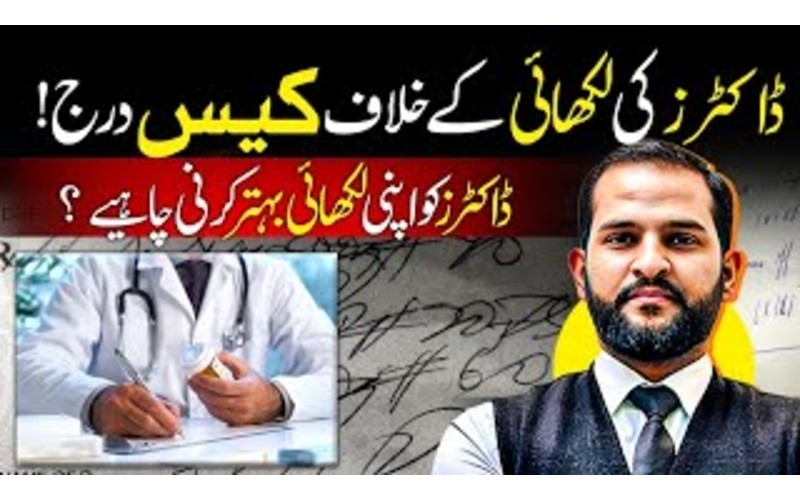
Today, we filed a Public Interest Litigation (PIL) on a matter that affects millions of Pakistanis every single day: unclear and unreadable doctor prescriptions.
Every year, countless patients visit doctors seeking treatment. Yet the biggest problem they face is not always the illness — it is the handwriting on prescriptions.
Doctors write medicines, dosages, and timings in a manner that most patients cannot understand. Sometimes, even pharmacists struggle to read them correctly. This leads to:
-
Wrong medicines being dispensed
-
Incorrect dosages
-
Serious health risks
-
Avoidable complications
This is not a minor issue. This is a fundamental rights issue.
It Is a Fundamental Right to Understand Your Treatment
Every citizen has:
-
The right to life
-
The right to information
A patient has the legal and moral right to know:
-
Which medicine is being prescribed
-
What its composition is
-
How often it must be taken
-
For how long it should be used
Doctors are highly educated and intelligent professionals. Yet when it comes to writing prescriptions, many still use handwriting that only a pharmacist might decode — and sometimes even pharmacists get it wrong.
This puts patient safety at serious risk.
Our Legal Action
To address this systemic problem, we submitted formal applications to:
-
Pakistan Medical & Dental Council (PMDC / PMC)
-
Punjab Healthcare Commission (PHC)
-
Healthcare Commissions of all provinces
-
Federation of Pakistan
We also filed a petition titled:
Tauseef Ahmed vs Federation of Pakistan
The matter was heard before the honorable court, where directions were issued to the respondents to decide our representations within a stipulated timeframe.
If these applications are not decided properly and fairly, we will proceed with contempt proceedings and submit formal objections.
Why This Matters So Much
Across the world, healthcare systems have moved toward e-prescriptions (electronic prescriptions).
Even courts stopped handwritten petitions decades ago — today, everything is typed and properly formatted.
So why should medical prescriptions — which directly affect human life — still rely on unreadable handwriting?
Personally, when I took my daughter to a hospital, I had to sit with the doctor and record explanations just to understand:
-
Which medicine was prescribed
-
When to give it
-
How much to give
This should never be necessary.
Healthcare must be clear, accessible, and safe.
The Way Forward
We strongly believe Pakistan must move toward:
-
Typed or electronic prescriptions
-
Clear dosage instructions
-
Standardized medical formats
This will:
-
Reduce medication errors
-
Protect patients
-
Improve accountability
-
Strengthen public trust in healthcare
Final Thoughts
This PIL is not against doctors.
It is for patients.
It is about protecting lives, ensuring transparency, and enforcing the basic right to understand one’s own medical treatment.
We invite the public to share in the comments:
What other issues should we raise through Public Interest Litigation?
Together, we can push for meaningful reform.