
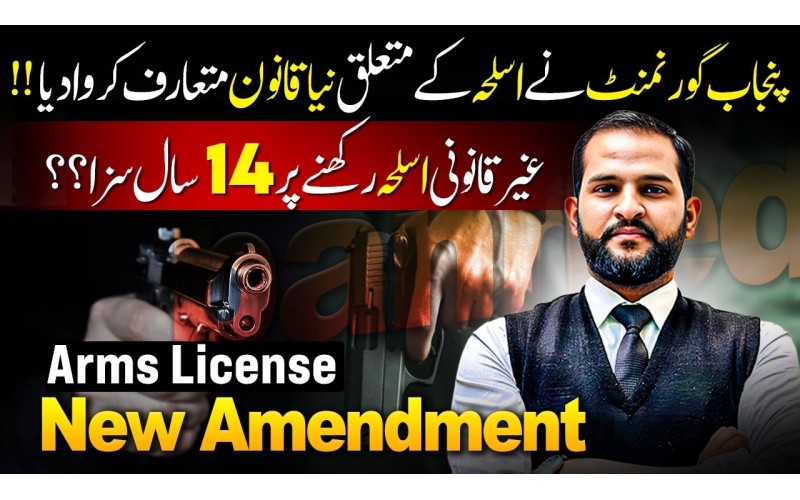
For the past few days, news has been circulating that the Punjab Government has announced a complete halt on issuing weapon licenses. This has created confusion among citizens:
Is this a new law?
Is it merely a policy announcement?
And most importantly, does Punjab even have the constitutional authority to do this?
Let’s break it down in simple terms.
Federal vs Provincial Powers: Who Controls Weapons Law?
When Pakistan came into existence, a federal system was established. Under this system:
- The Federal Government, headed by the Prime Minister, governs from Islamabad.
- The Provincial Governments, headed by Chief Ministers, administer their respective provinces.
Originally, under the 1973 Constitution of Pakistan, the power to legislate on arms and weapons rested solely with the Federal Government.
However, everything changed with the 18th Constitutional Amendment in 2010. Through this landmark amendment, many subjects, including arms regulation, were devolved to the provinces. This means that each provincial government now has the authority to make laws regarding weapons within its territory.
In Punjab, this responsibility lies primarily with the Home Department, while implementation (licenses, renewals, suspensions, cancellations) is carried out by Deputy Commissioners.
The Legal Framework: From 1965 to Punjab Arms Act
Pakistan originally operated under the Arms Ordinance of 1965, a federal law.
After devolution:
- Khyber Pakhtunkhwa, Sindh, Balochistan, and Punjab adopted this ordinance with province-specific amendments.
- Punjab formally converted it into the Punjab Arms Ordinance in 2014, introducing its own rules and procedures.
Under Section 13 of this law:
Non-Prohibited Bore Weapons
- Possession: up to 5 years imprisonment
- Carrying/displaying: up to 7 years
Prohibited Bore Weapons
- Possession: up to 7 years
- Carrying/displaying: up to 14 years
These punishments were already part of the law long before the current announcements.
What Changed in 2025?
On 21 May 2025, the Punjab Assembly passed the Punjab Arms (Amendment) Act, 2025.
- The Governor gave assent on 29 May 2025.
- It officially became law on 30 May 2025.
Importantly:
This amendment did NOT increase imprisonment terms.
It only increased financial penalties (fines).
So claims that jail terms were newly raised to 14 years are misleading, those provisions already existed.
Is the “No New Weapon Licenses” Decision a Law?
At present, the Punjab Government’s declaration about stopping new weapon licenses appears to be:
✅ A policy announcement
❌ Not backed by any fresh legislation passed by the Punjab Assembly
No new amendment bill has been introduced to legally enforce a complete ban on issuing licenses.
Therefore, unless formal legislation follows, this remains an executive or administrative decision, not a statutory change.
A Personal Perspective: Do Civilians Really Need Weapons?
From a broader social viewpoint, one uncomfortable truth stands out:
Law-abiding citizens rarely need firearms.
Criminals misuse weapons whether licensed or illegal.
Street violence, neighborhood intimidation, and casual gun culture continue to harm our society. A complete civilian disarmament policy, with weapons restricted strictly to law-enforcement agencies, could significantly reduce everyday crime and restore public confidence.
If Pakistan truly wants safer streets, the ultimate solution is simple:
Remove weapons from civilian life altogether.
Final Thoughts
Punjab does have constitutional authority over weapons regulation after the 18th Amendment.
However, the recent announcement about stopping weapon licenses is not yet supported by new legislation.
Until the Punjab Assembly passes another amendment, this remains a policy move, not a permanent legal ban.
Transparency, proper lawmaking, and public awareness are essential if such serious decisions are to gain legitimacy and trust.